
In the wake of Donald Trump‘s stunning 2016 election victory, comedian Dave Chappelle hosted Saturday Night Live and delivered a monologue that captured the nation’s mixed emotions. “I’m going to give him a chance,” Chappelle said, speaking for many skeptical people, “and we, the historically disenfranchised, demand that he give us one too.”
It was a call for cautious optimism, a recognition that even amid deep divisions, the success of a leader matters to everyone. Now, nearly a decade later, New York finds itself in a similar spot with Zohran Mamdani, the young socialist who swept into the mayor’s office after a historic win. We want him to succeed — not out of blind faith, but because New York’s prosperity is vital to the nation.
As a native New Yorker, Trump himself understands this — his recent White House meeting with Mamdani underscored a shared interest in the city’s well-being, despite their ideological chasms. And yes, there have been promising signs, such as the inauguration’s use of three holy texts, symbolizing America’s pluralistic promise. But other early moves have left many disconcerted, raising questions about whether this administration will unite or further fracture the city that never sleeps.
A historic handover amid high hopes
Mamdani’s path to Gracie Mansion was anything but conventional. At 34, the state assemblyman from Queens became the first Muslim and first South Asian to lead New York City, defeating a field that included heavyweights such as former New York Gov. Andrew Cuomo and Republican Curtis Sliwa in the November 2025 general election. With 50.78% of the vote, Mamdani’s victory was narrow but decisive, fueled by a coalition of young voters, progressive Democrats, and communities frustrated with rising costs and inequality. His campaign, backed by figures such as Rep. Alexandria Ocasio-Cortez (D-NY) and Sen. Bernie Sanders (I-VT), promised bold reforms: universal child care, rent stabilization, and a reimagined approach to public safety that emphasized community oversight over traditional policing.
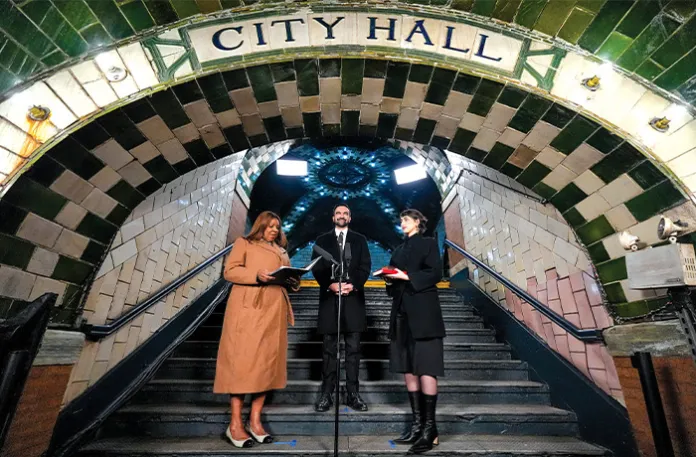
The inauguration on Jan. 1 was a spectacle of diversity. Held outdoors despite freezing temperatures, it drew thousands of supporters to City Hall Plaza. Mamdani took his oath on a centuries-old Quran from his grandfather, a nod to his Ugandan and Indian roots and the city’s immigrant fabric. But the ceremony’s true symbolism came in the swearing-in of other officials: a Christian Bible for one; a Chumash, the Five Books of Moses, for a Jewish colleague; and the Quran for Mamdani himself. It was a powerful image, evoking the American ideal of a melting pot where a variety of faiths can coexist. “Where else could a Muslim kid like me grow up eating bagels and lox every Sunday?” Mamdani quipped in his address, pledging to govern “expansively and audaciously” for all New Yorkers.
This moment of unity was echoed in Mamdani’s preinauguration meeting with Trump on Nov. 21, 2025. After months of barbs — Trump had called Mamdani a “radical socialist,” while Mamdani critiqued Trump’s policies — the Oval Office sit-down was surprisingly cordial. They discussed affordability: rent, groceries, and utilities. Trump, ever the New Yorker, expressed a desire for the city to thrive. “We’ve just had a great meeting,” Trump said afterward. “A really good, very productive meeting. We have one thing in common: We want this city of ours that we love to do very well. … The better he does, the happier I am.” Mamdani echoed the sentiment, noting their shared admiration for the Big Apple. For a city bracing for federal clashes, this olive branch offered a glimmer of bipartisanship in an otherwise polarized era.
Yet, as the confetti settled, the honeymoon showed cracks. Mamdani’s first acts signaled a sharp pivot from his predecessor, Eric Adams, whose administration had prioritized law-and-order and pro-Israel stances. In his first 10 days, Mamdani issued 12 executive orders, far outpacing the prior administration’s output over months, focusing on housing, consumer protections, and more. While some hail this as decisive action, others see it as ideological overreach. On his very first day, he visited a rent-stabilized apartment in Brooklyn to highlight disrepair problems, announcing measures to boost tenant protections and accelerate housing development through task forces reviewing city-owned land and streamlining permits.
Revoking safeguards: A shift on antisemitism and Israel
One of Mamdani’s earliest moves was to revoke several executive orders issued by Adams in his final months, including two that had bolstered measures against antisemitism. Adams had signed an order barring city agencies from boycotting, divesting from, or sanctioning Israel, aligning with anti-BDS efforts. Another adopted the International Holocaust Remembrance Alliance definition of antisemitism, which includes certain criticisms of Israel as possibly hateful. These were seen by supporters as vital protections amid rising incidents of antisemitism in the city.
On Jan. 2, Mamdani’s second day in office, he rescinded these orders as part of a broader sweep of Adams-era directives issued after the latter was indicted on Sept. 26, 2024. The Israeli foreign ministry swiftly accused him of “fueling antisemitism,” calling it “antisemitic gasoline on an open fire.” A coalition of Jewish groups, including the UJA-Federation of New York, the Jewish Community Relations Council, the Anti-Defamation League, Agudath Israel of America, the New York Board of Rabbis, and the Orthodox Union, issued a joint statement blasting the decision. They described it as reversing “significant protections against antisemitism” and warned that the Jewish community would watch closely for sustained leadership on the issue, while praising his retention of the Office to Combat Antisemitism.
Mamdani defended the revocations, arguing they were necessary to refocus on pressing local issues such as housing and to provide a “clean slate” for his administration. He pledged to maintain Adams’s Office to Combat Antisemitism, emphasizing that the city takes the issue “very seriously” and that protecting Jewish New Yorkers remains a focus. Still, critics argue this sends a troubling signal. By dropping the IHRA definition, they say, Mamdani risks blurring lines between legitimate criticism and hate, especially in a city with the largest Jewish population outside Israel. Lifting the anti-BDS measure could embolden activists targeting Israel, possibly straining New York’s economic ties with the Jewish state. The move drew sharp rebukes from conservative leaders and Adams, who framed it as undermining Jewish safety.
This isn’t isolated — it reflects Mamdani’s broader embrace of far-left voices. During his campaign, he rallied with Ocasio-Cortez and Sanders, who introduced him at the inauguration. Ocasio-Cortez, known for her sharp critiques of Israel, has been a vocal ally, stumping for Mamdani and celebrating his win as a progressive triumph. While this energizes his base, it alienates moderates and conservatives who see it as aligning with radicals at the expense of mainstream consensus. In his inaugural speech, Mamdani shouted out Ocasio-Cortez and Sanders, reinforcing this perception.
Problematic picks: Appointments under fire
Mamdani’s administrative selections have further fueled concerns, blending progressive activists with symbolic firsts but drawing scrutiny for ideology over experience. Take Cea Weaver, appointed executive director of the Office to Protect Tenants on Jan. 1. A longtime tenant activist and member of the Democratic Socialists of America, Weaver has been polarizing. Resurfaced social media posts from 2017 to 2019 include calling homeownership “a weapon of white supremacy masquerading as ‘wealth building’ public policy,” advocating to “seize private property,” and stating it’s important to “impoverish the white middle class.” Some posts described private property as a “collective good.”
Weaver expressed regret, saying such statements “are not something I would say today” and emphasizing her focus on tenant protections. Mamdani stood by her, defending her track record in advocacy and noting she was fully vetted. But critics, including Adams, who called her views “out of your f***ing mind,” and conservative commentators, argue that this appointment signals an anti-property rights agenda that could deter investment and exacerbate the city’s housing crunch. “My focus as the mayor is to protect tenants,” Mamdani said, but for homeowners and landlords, it feels like a declaration of war. The controversy has even drawn attention from federal officials, with warnings about civil rights implications.
Even more contentious was the brief appointment of Catherine Almonte Da Costa as director of appointments. Announced on Dec. 17, 2025, it unraveled within 24 hours when old social media posts surfaced, including derogatory remarks about “money hungry Jews” from 2011 to 2012. The Anti-Defamation League and others correctly condemned them as antisemitic tropes. Da Costa, now married with Jewish children, apologized profusely, calling the posts a “distraction” and expressing “deep regret.” Mamdani accepted her resignation immediately, but the episode highlighted the new mayor’s vetting lapses and amplified the fears that many of us Jewish New Yorkers have had that Mamdani would not be sufficiently vigilant in the, unfortunately, ever-increasing need to combat antisemitism.
Other picks have stirred debate as well. New York City Fire Commissioner Lillian Bonsignore is the first openly gay person and second woman in the role, but a veteran of Emergency Medical Services rather than a traditional firefighter, drawing ire from figures such as Elon Musk, who posted that “people will die” under her leadership due to a lack of proven firefighting experience. Mamdani defended her, noting that EMS handles 70% of New York City Fire Department calls and praising her crisis leadership during COVID-19. Sam Levine at the Department of Consumer and Worker Protection is seen as pro-labor to a fault, possibly alienating businesses. Dean Fuleihan, as first deputy mayor, brings experience but ties to the Bill de Blasio era, which conservatives view as bloated and inefficient.
These choices reflect Mamdani’s progressive tilt: prioritizing diversity and activism. His “Trump-proofing” strategy, appointing legal experts to shield policies from federal overreach, adds another layer, positioning the city for battles with Washington. Yet this strategy looks like ideology trumping pragmatism, which could risk operational chaos in a city that’s already grappling with post-pandemic recovery.
Promises in flux: From campaign trail to City Hall
Mamdani campaigned on transformative change, vowing universal child care, rent controls, and democratic participation. In his first 10 days, he delivered on some fronts: executive orders reviving tenant protections; creating task forces to accelerate housing, including reviewing city-owned land for 25,000+ units and streamlining permits; launching “rental ripoff” hearings for tenant testimony against negligent landlords; and targeting junk fees and deceptive subscriptions. On Jan. 6, he signed emergency orders to improve Rikers Island conditions, end solitary confinement, and bring homeless shelters into compliance with safety codes. On Jan. 8, he announced expansions for free child care, starting with 2-year-olds, backed by state funding — a step toward his universal pledge. He has also addressed smaller quality-of-life issues, including paving over a dangerous bump in the Williamsburg Bridge bike lane.
Supporters praise this as defying “rightwing predictions of a far-left hellscape,” with groups such as the New York Democratic Socialists of America hailing the child care move as a “big win.” Mamdani has emphasized blunt truths about inherited problems, such as Rikers Island conditions, and committed to compliance plans within tight timelines.
WASHINGTON’S ECHO: AMERICA AND EUROPE AT A CROSSROADS ONCE MORE
But skeptics point to possible dilutions and challenges. Implementing full universal programs will require navigating Albany, a tight budget, and public investment crises. Critics from the Right argue he’s already moderating — witness his restrained criticism of Trump after their meeting — or sidelining other promises, such as robust antisemitism protections, in favor of ideological realignments. Charter schools report a “rocky start” with Mamdani, seeking improved ties amid fears of caps or funding cuts. Economic watchers warn his tax-and-spend approach could accelerate the “slow-motion exodus” of businesses and residents, especially as high-profile figures in finance and tech continue to voice concerns about the city’s direction.
As Mamdani settles in, those of us in New York are holding our collective breath. The inauguration’s holy texts moment was uplifting, a reminder of what makes this city exceptional. His meeting with Trump hints at possible cooperation on affordability. But the revocations, appointments, and perceived shifts from campaign rhetoric unsettle many. We want him to succeed — for the subways to run, the streets to stay safe, and the economy to hum. Like Chappelle with Trump, we’re giving Mamdani a chance, and demanding that he extend one to us in return. The city’s future depends on it.
Daniel Ross Goodman is a Washington Examiner contributing writer and the Allen and Joan Bildner Visiting Scholar at Rutgers University. Find him on X @DanRossGoodman.