
The new Gus Van Sant film, Dead Man’s Wire, is the latest entry in what might be called the “crazy people doing crazy things on live TV” genre. This places the movie within the tradition of Dog Day Afternoon or Network, whose lead characters are explicitly or implicitly mad as hell and behave accordingly on TV. But unlike those classics directed by the incomparable Sidney Lumet, Van Sant’s movie lacks a properly critical perspective on its central antihero. The film prefers to paint its protagonist less as a nutcase and more as a folk hero.
Dead Man’s Wire purports to tell the true story of Tony Kiritsis, an Indianapolis malcontent who, in 1977, kidnapped a mortgage company official by lassoing a wire around his neck, tethered to a sawed-off shotgun. The ghastly episode, which culminated in an apocalyptically fascinating press conference with Kiritsis and his victim, occurred within a few years of the release of the Lumet films. It’s a perfectly natural subject for a movie. Unfortunately, the drama inherent in the scenario is undermined by the strained sincerity with which Kiritsis’s allegedly virtuous socioeconomic agenda is presented.
Tony is played by Bill Skarsgard, who, apart from his tacky attire and ’70s facial hair, barely resembles the real man (who died in 2005). Kiritsis was stocky and sort of a roughneck, while Skarsgard is lanky and speaks somewhat in the manner of actor Michael Shannon at his most spaced-out. In the early going, when the film is at its most fun and least solemn, this works to Skarsgard’s advantage. Far from being an earnest voice for the working stiff, Tony comes across like a slow-witted yokel as he ambles into the Meridian Mortgage building bearing an oddly proportioned cardboard box. He stumbles and fumbles as he seeks to meet with company head honcho M.L. Hall (Al Pacino, a scene-stealer here).
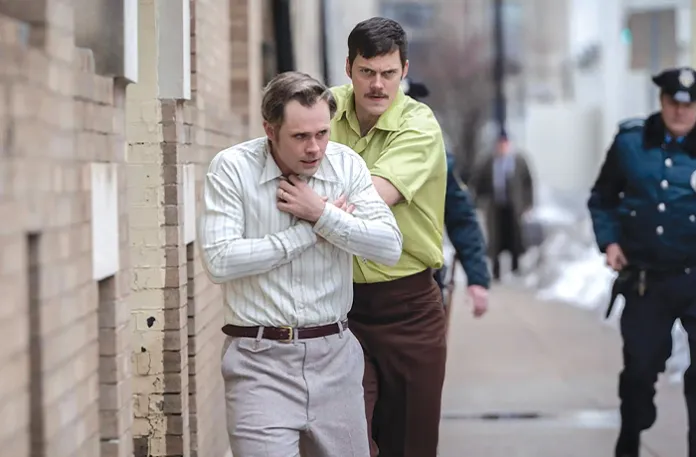
When Hall is revealed to be vacationing far from the Midwest, Tony must settle for the old man’s son, Dick (Dacre Montgomery), to whom he states the reason for his visit. Tony has developed a tract of land for large commercial tenants, but he has become persuaded that Meridian, which holds the mortgage, has steered tenants from the property and thus has brought about his downfall. Don’t all mortgage companies have it in for the little guy? Tony may or may not have been a legitimate gripe, but he is prone to speak in insufferable populist platitudes such as, “They set you up to try to take everything you got,” or, “This company has done me wrong, so I’m going to let the world know what you and your dad have done to me.” There is no indication that the film wishes to distance itself from these sentiments.
Tony’s method of informing the public, so to speak, is to make a hostage of Dick, who, due to the apparatus to which he is affixed, will surely be killed if he stumbles, runs, or even grows light-headed. (It will also discharge if Tony, to whom the wire is also connected, is fired upon.) While Skarsgard delivers increasingly tendentious talking points, Montgomery, as Dick, has few acting choices available to him except to lurch and stagger from place to place, all the while hunched over. Nonetheless, Van Sant extracts a fair amount of dark comedy from the situation, largely from the crazy quilt of supporting characters who cross paths with Tony and Dick. There is the detective who, in an admission of the ingenuity of Tony’s contraption, mainly instructs policemen to put their weapons away. Then there is the priest, who exhorts Tony to reconsider his actions, to which the kidnapper replies, “It’s Tuesday, not Sunday, Father.” Give him this: Tony never bats an eye while carrying out his plan, which includes compelling Dick, still attached to the shotgun rig, to drive a stolen police car to Tony’s apartment (also full of deadly booby-traps).
It is amusing when Tony, still in the police car, attempts to deploy the speaker to address his pursuers but instead presses numerous buttons, causing the car to wail its sirens. And Van Sant seems to be dusting off some of the news media satire of his best film, 1995’s To Die For, with Nicole Kidman, when he gives a prominent part to Myha’la. She plays a local news reporter who phones in the initial news this way: “It looked like a white guy strapped a shotgun to another white guy’s head.”
Yet much of the comedy evaporates from the film once Tony and the authorities settle into a stand-off. This is less because the predicament in which Dick finds himself is truly heinous, so much so that Van Sant is determined to present Tony as having been genuinely wronged by Meridian Mortgage. We get a clue to the film’s anti-rich sentiments when Pacino’s character, M.L., is shown on vacation and fussing over an improperly prepared burrito. (He says it has been halved rather than divided into thirds as he prefers.) Such expressions of outrage at the ultrarich, even the regionally ultrarich, like big shots at an Indianapolis mortgage firm, are about as dated as Occupy Wall Street. “Let me guess — you’ve got a boat,” Tony says to Dick at one point, and the line is read not with a sense of comedy about Tony’s resentment but with a sense of righteous indignation that validates his grievances.
THE FRENETIC CHARM OF ‘MARTY SUPREME’
Undoubtedly, Van Sant does not mean to justify or minimize Tony’s objectively psychotic actions, but the filmmaker presents no alternative fact set to Tony’s contention that “I saw something in that land that no one else did.” We are treated to a sob story of how he worked hard selling ice cream and used cars earlier in his life. Meanwhile, his hostage groans, grimaces, and suffers indignity upon indignity while in captivity. When Tony insists upon not only compensation but an apology from Meridian, perhaps we are meant to laugh at his naïveté. But we are surely meant to scoff when M.L. declines on the (perfectly reasonable) grounds that he has done nothing to necessitate an apology — certainly nothing egregious as strapping a sawed-off shotgun to someone’s head. The film’s weird sympathy with Tony is underscored when he forms an on-air relationship with an Indianapolis jazz DJ named Fred Temple (Colman Domingo), who at least pretends to grasp his plight. Admittedly, when Tony first calls Fred, he gets a funny opening line: “Long-time listener, first-time caller.”
For those who doubt that Dead Man’s Wire means to be an attack on lenders, banks, and presumably other big businesses generally assumed to prey on ordinary folks, consider the film’s completely perverse treatment of Kiritsis’s fate. I will not reveal that here, but to the extent that he evaded major responsibility for his inarguable crimes, the film rejoices in that outcome. In movies like Dog Day Afternoon and Network, we may have fleetingly enjoyed the leading characters’ urge to stick it to the man, but the films never lost their sense of proportion about the outrageousness of their behavior. By contrast, Dead Man’s Wire exists in a moral grey zone, neither edifying nor entertaining. Let me be the first to say: Do not let Van Sant anywhere near the story of Luigi Mangione.
Peter Tonguette is a contributing writer to the Washington Examiner magazine.