
Canadian Prime Minister Mark Carney announced on Friday he is dropping special tariffs on Chinese electric vehicles, marking Ottawa’s latest move to deepen ties with countries it views as more “predictable” than the United States.
Under the “landmark” deal, Canada is allowing 49,000 of the vehicles into the country, dropping 100% tariffs on Chinese EVs it placed on Beijing in 2024 that echoed similar U.S. penalties, and moving China back to the default “most-favored nation” tariff rate of 6.1%. The development, hailed as a “new strategic partnership” with China by Carney, signals he is serious about efforts to boost relations with Asia after 13 months of a volatile trade relationship with Washington, once viewed as the country’s most reliable trading partner.
“This is a return to levels prior to recent trade frictions, but under an agreement that promises much more for Canadians,” Carney told reporters, referencing Beijing’s commitment to reduce the tariff on imports of Canadian canola seed from an 85% rate to 15% by March 1, and ensure visa-free access for Canadians travelling to China.
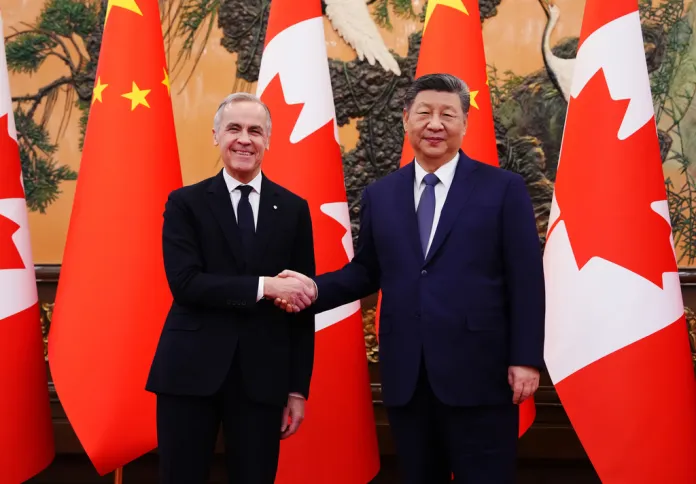
Carney made the remarks after meeting with Chinese President Xi Jinping in Beijing, notably marking the first visit to China by a Canadian leader in nearly a decade. Carney also met senior executives from prominent Chinese businesses, including an EV battery maker and an energy giant. He made several agreements on energy and trade cooperation, which he said were designed to help Canada “build its own competitive EV sector,” by following opportunities to “learn from innovative partners, access their supply chains, and increase local demand.”
Strengthening ties with Asia and Europe is a critical piece of Carney’s strategy to wean Canada from dependence on the U.S. and shield itself from the weight of Washington’s tariffs. The prime minister has repeatedly said he wants to reduce barriers to trade with Asia and Europe as a self-protection mechanism, and to take away “the cards” the U.S. holds against Ottawa in negotiations on economic matters and other issues.
“Getting rid of barriers east, west … You know that alone, if it’s fully done — we’ve done the federal part — but if all our provinces reduce their barriers, the estimates are that is a bigger return to the Canadian economy than the worst case trade outcome with the U.S.,” he said during September 2025 remarks at a Council on Foreign Relations conference.
“Who has all the cards? There are other games. There’s not just one game,” the prime minister warned during an interview with the Economist the following month, referencing an analogy President Donald Trump has used regarding foreign relations. “That’s the point. There are other games, and yes, we’re going to spend more time, to extend the analogy, in the game with the United States, but we’re going to play other games with other players.”
TRUMP TELLS SUPREME COURT STRIKING DOWN TARIFFS WOULD ‘DISARM’ HIM ON INTERNATIONAL TRADE
“Part of the reason why countries end up in, quote, ‘having’ to do one or negotiating from the position they’re in is their degree of dependence on the United States. So the logical thing … is, well, we should take care of ourselves, do the stuff at home, and we should build up relationships abroad … really focusing on building up that outside option,” he added.
On Friday, Carney said his new deal with China would unlock nearly $3 billion in export orders for Canadian farmers, fish harvesters, and processors. Partnerships for natural gas exports were announced as well. Carney promised the Canadian production of 50 million annual metric tonnes of liquefied natural gas destined for Asian markets by 2030, said Canada will double its energy grid over the next 15 years, and expressed confidence in opportunities for Chinese partnership on offshore wind investments.