
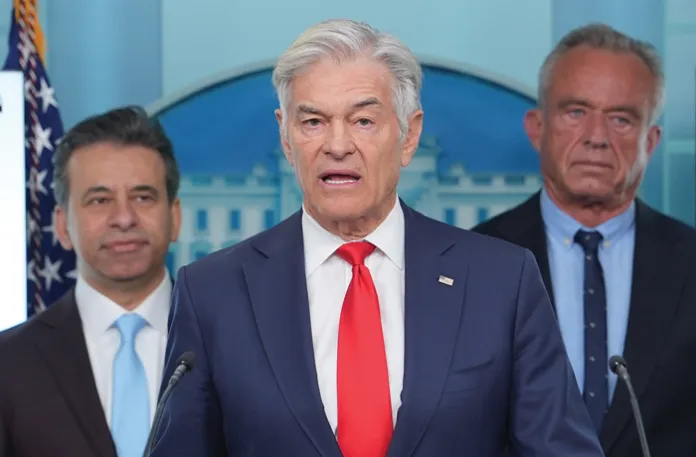
Dr. Mehmet Oz — one of the few members of President Donald Trump’s second administration who might once have rivaled him for network television fame — played to that very strength in early January while introducing the Department of Health and Human Services’s new alcohol consumption guidelines. Defending the Trump administration’s decision to ditch long-standing advice that drinkers limit themselves to two tipples per day for men and one for women, Oz offered reporters a pithy sound bite by way of personal advice: “Don’t have it for breakfast.”
While the official report sounds a note of caution, in his remarks, Oz offered an unexpected, garbled defense of drinking in the face of trends toward sobriety (just 54% of Americans reported drinking at all in the most recent polling from Gallup, the lowest rate recorded since its polling began in 1939). “Alcohol is a social lubricant that brings people together,” he said, adding that while “in the best-case scenario, I don’t think you should drink alcohol,” it provides “an excuse to bond and socialize, and there’s probably nothing healthier than having a good time with friends in a safe way.” Subtext: Amid mounting concern over Americans’ psychological isolation — the death of civic life, declining marriage and birth rates, the anecdotal but undeniable growth of antisocial public behavior — alcohol has some role to play in encouraging conviviality.
Official public health messaging about alcohol has traditionally followed the spirit of the “precautionary principle,” erring on the side of overconcern rather than common sense, or in many cases, even accuracy. The administration’s new dietary guidelines, on the other hand, simply carry an ambivalent recommendation for Americans to “Consume less alcohol for better overall health,” flying in the face of growing concern from the medical community about its possible carcinogenic qualities (although the direct connection between drinking and cancer remains inconclusive).
Almost exactly a year prior to the new rules’ unveiling, the previous surgeon general, Dr. Vivek Murthy, called for alcohol to carry a warning label akin to those on packs of cigarettes. America’s pantries, refrigerators, and liquor cabinets are no strangers to this kind of bureaucratic paternalism. The food pyramid itself has its origins in WWII-era fear about malnutrition, and HHS Secretary Robert F. Kennedy Jr.’s new dietary recommendations are clearly inspired by the scientifically ambiguous world of fitness influencers.
Which makes it all the stranger that the second Trump White House — otherwise a machine for turning inchoate ideology into explicit, prescriptive policy decisions — has hesitated to take a strong stance against alcohol. The episode reveals something more uncomfortable, unmanageable, and possibly dangerous about booze’s role in modern society, although not necessarily in the way its critics might first think.
Whether one is a MAGA diehard, a bien pensant liberal, a revolutionary communist, or one of this country’s increasingly endangered never-Trump Republicans, one of the few qualities of Trumpian governance that nearly everyone should appreciate is its forthrightness in turning right-wing sentiment into policy reality. No longer do we live in the world of the “nudge,” where citizens were “encouraged” to make Ivy League experts’ desired lifestyle “choices” through the gradual, invisible removal of all alternatives. Trumpian policy is, at least, open and frank: These are the ruling ideology’s desires and demands, and one can choose to comply or not.
Or, to quote another deeply polarizing two-term president: Elections have consequences. They are also consequences of cultural changes. And culture has certainly changed in recent decades when it comes to public health and individual personal responsibility for bodily well-being, whether in the backlash to COVID-19 lockdowns or perhaps overcompensating for said lockdowns’ implicit invitation to hole up drinking alone in one’s home for years on end. That makes it all the stranger that in a world where seemingly everything is fodder for Manichean culture war, with nearly every taboo off the table, a Trump 2.0 official would speak in such a muddled tone. Oz’s equivocation ultimately reflects the impossibility of offering any kind of overt endorsement of alcohol in a modern society obsessed with quantifying, measuring, and planning our physical, mental, and even spiritual and civic health.
For evidence of this, look no further than Bryan Johnson, the plasticine, teetotaling Silicon Valley revenant obsessed with “biohacking” his way to immortality, who has become arguably the defining tabloid icon of this era, famous for nothing else but his eccentricity and relentless self-promotion. He plays the same role of scapegoat for our obsessions and pathologies as the hypersexualized, hypermaterialistic Anna Nicole Smith did in the lux, louche 1990s, or as Marilyn Monroe did in a post-WWII America just beginning to redefine its moral relationship to sexuality. (Johnson’s comparative sexlessness says as much about that relationship today.)
Alcohol has no role in such a society. It resists endorsement and invites prohibition because it is an engine for pure, value-neutral pleasure. In other words, the bad things about it are measurable, and the good things about it are immeasurable. Socializing, flirting, and the basic animal feeling of tipsiness do not contribute in any empirically quantifiable way to your well-being, and in fact often lead to ruinous overindulgence. Drinking is ultimately useless, as well as uncontrollable. Its use and possible overuse can only be regulated through deep inner cultivation and self-knowledge, and therefore, in our anti-introspective, technological society, it is highly suspect.
To stand behind a podium and say “drink, and know thyself” would fly in the face of the very project of “public health.” It could hardly be expected from even the most reflexively antiestablishment government conceivable, i.e., the current one. If nothing else, then, the unwillingness of the current government to take a definitive stance either way on the subject pays its own kind of implicit tribute to the evanescent, anarchic spirit of boozing — and human nature — that otherwise has no business in the realm of politics and policy.
Derek Robertson is a writer in Brooklyn.