
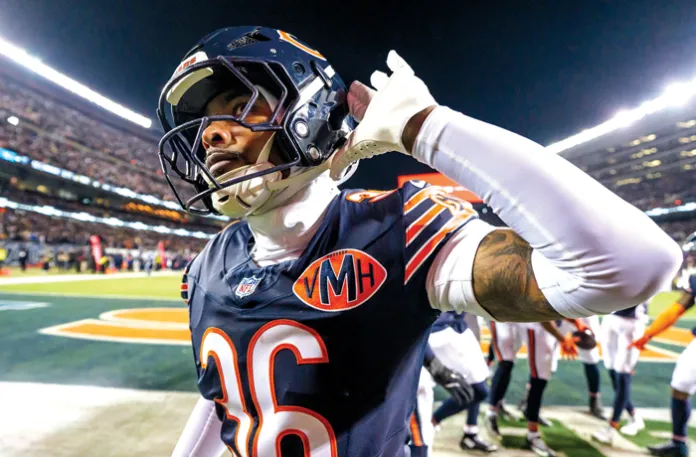
If you were hoping to watch the NFL Wild Card Weekend playoff game between the Green Bay Packers and the Chicago Bears, and you were not already a member of Amazon Prime, you were out of luck.
Amazon paid a reported $150 million for the rights to that one playoff game this year. This is on top of the $100 million it paid for exclusive rights to a Black Friday game and the $1 billion a year to stream Thursday Night Football games throughout the season.
In an era of increasingly fragmented audiences, it is easy to understand why media giants such as Amazon and Netflix are willing to pay a premium for NFL rights. According to Nielsen, 40 of the top 50 television broadcasts in 2024 were NFL games, with college football accounting for two more. The only other programs to crack the top tier were the presidential and vice presidential debates, and the Thanksgiving Day parade, which stood alone as the sole non-sports, non-political broadcast to make the list.
Live sporting events are at the center of an economic battle between media giants right now. Disney recently yanked all of its football programming from Google’s YouTube TV in an attempt to extract higher fees. The previously mentioned Amazon and Netflix have both been aggressive in the live sports arena and are looking to spend even more. Paramount/CBS and Comcast/NBC also spend considerable money on live sporting events, both to support their current broadcast business models and look to establish themselves in the growing streaming market.
There are literally trillions of dollars involved in this media war, and no one knows what the winning business model will be. It is very tempting for free-market-minded individuals to sit back and let the media giants fight it out, but what if something is lost in the process?
America used to have a common culture. For most of the 20th century, large national events — the Super Bowl, the World Series, the Oscars, the Emmys, even sitcoms — were experienced together, at the same time, by rich and poor alike, free over the air. These shared rituals gave Americans with little else in common a sense that they still belonged to the same community.
But that is fast disappearing. And not just in the media. Disney used to pride itself on being available “to as many families as possible.” Now, it specifically targets the wealthiest individuals, a group that often does not include children. Increasingly, a society already divided by politics and geography is now also divided by class, with some entertainment options reserved only for those with the most disposable income.
The case for letting the NFL take top dollar from any media platform, regardless of whether or not the games will be made available to all, would be stronger if the NFL were a free-market enterprise. But it’s not.
SPORTS BETTING APPS ARE WORSE THAN YOU REALIZE
Just look at the Kansas City Chiefs, who just took $3 billion from taxpayers to build their new stadium. Or the Chicago Bears, who are looking for taxpayers to pick up at least $2 billion for their new stadium.
If NFL owners want to continue to dip their beaks in taxpayer coffers to subsidize their stadiums, they have no right to complain if Congress turns around and starts setting some requirements on how games can be sold to media companies. When the stadium is public, the game probably should be too.