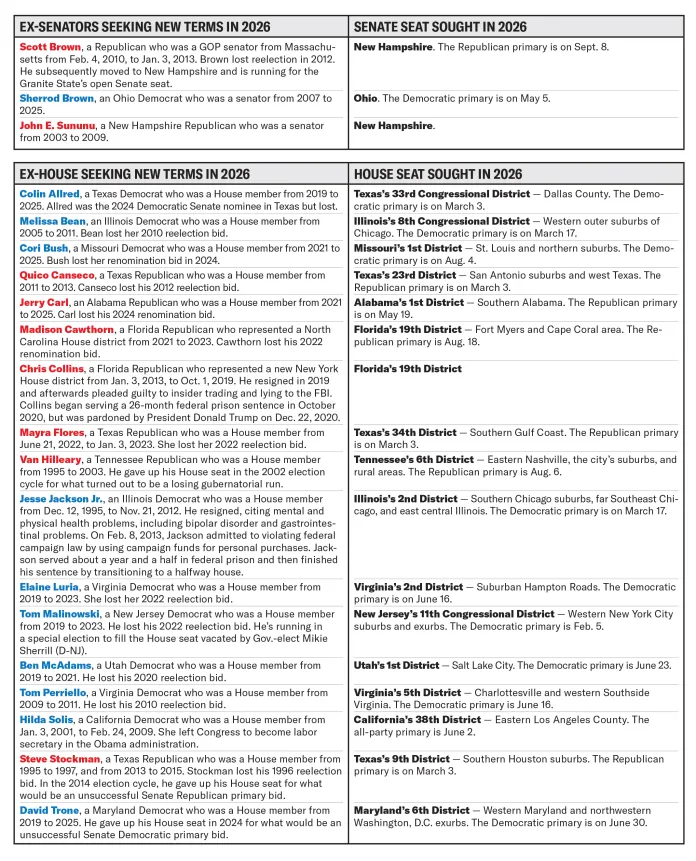
Sherrod Brown isn’t the only former senator with the name abbreviation “S. Brown” seeking a comeback in the 2026 midterm elections. The Ohio Democrat is joined by, among others, former Sen. Scott Brown of New Hampshire, who was, briefly, an Obama-agenda-thwarting Republican hero a dozen years ago.
The Browns, along with former Sen. John E. Sununu, a New Hampshire Republican seeking his old Senate seat, face tough historical headwinds in the 2026 midterm election cycle. No senator who has lost a reelection bid subsequently won a seat since 1988. Back then, the late Republican Sen. Slade Gorton of Washington triumphed two years after losing the state’s other Senate seat, which he had held for a single, six-year term.
But in the political era of President Donald Trump, past precedents need not necessarily apply. And each ex-senator is betting that the political climate is more favorable than when voters previously rejected them. All part of a broader Senate landscape in which Democrats need to win four seats in the 100-member chamber to claim a majority after two years in the political wilderness.

Sherrod Brown is running in a 2026 special election for the Ohio Senate seat held for two years by Vice President JD Vance, before Trump in 2024 tapped him as his understudy, and the pair won. Sen. Jon Husted (R-OH) got appointed to replace Vance, and he’s now facing an election in his own right for the final third of the six-year Senate term.
That’s where the Ohio Democrat comes in. The populist friend of organized labor was first elected to the Senate in 2006 after 14 years as a House member. He won that Senate race in a highly favorable Democratic year, beating a GOP incumbent.
Sherrod Brown then fended off well-funded reelection bids in 2012 and 2018 before meeting his political match in 2024 against Sen. Bernie Moreno (R-OH), a wealthy car dealership owner and Make America Great Again enthusiast. With Trump winning Ohio easily on his way to a second, nonconsecutive term, the political winds proved too intense for Brown to hold on.
Moreno won 50.09% to 46.7%. Still, Sherrod Brown strongly outperformed 2024 Democratic nominee Kamala Harris, as the then-vice president lost to Trump in Ohio 55.14% to 43.93%. This gives Democrats at least some reason for optimism about Brown in his 2026 comeback bid, as Trump’s approval ratings sink.
The New Hampshire Senate seat is coming open with the retirement of Sen. Jeanne Shaheen (D-NH) after the 2026 elections. Whoever emerges in the Sept. 8 primary will face Rep. Chris Pappas (D-NH), first elected in 2018. And in a vivid example of how limited the candidate pools can be in small population states, both Republican former senators have previously run against Shaheen, with varying degrees of success.
Sununu, 61, won his first and only Senate term in 2002 after beating 12-year incumbent Bob Smith in the GOP primary. Smith angered Senate Republicans when, in July 1999, he left the GOP fold to become an independent, citing an alleged lack of fealty to conservative principles by members of the Senate Republican Conference.
Smith switched back to being a Republican only four months later when a committee chairmanship opened up, but the internecine political damage had already been done with his GOP colleagues. In the 2002 midterm election cycle, President George W. Bush’s political operation recruited Sununu, a House member first elected in 1996, to challenge Smith. Sununu is the son and namesake of John Sununu, a former New Hampshire governor and White House chief of staff in the administration of President George H.W. Bush. Making John E. Sununu, at the time, a scion of New Hampshire political royalty.
John E. Sununu beat Smith in the primary, a rarity in Senate elections. That fall, he dispatched Shaheen, New Hampshire’s outgoing governor, as George W. Bush defied midterm election trends over the previous century, with Republicans padding their House majority and flipping the Senate to GOP control after a year-and-a-half under Democratic control.
Shaheen, as an ex-governor, bided her time politically, including during a stint in New Hampshire’s rival to the south, Massachusetts, leading Harvard University’s Institute of Politics at the Harvard Kennedy School. But Shaheen was back in the electoral arena when John E. Sununu faced reelection in 2008.
This time, political circumstances were dramatically different. With the economy cratering at the outset of the Great Recession, the Iraq War deeply unpopular and a host of other difficult circumstances confronting George W. Bush’s White House and congressional Republicans, Shaheen beat John E. Sununu in their rematch, 52%-45%. Barack Obama’s presidential victory helped seal the deal and expand Democratic congressional majorities.
But the U.S. electorate quickly soured on the Obama administration, including its push for healthcare legislation. Then the August 2009 death of a longtime advocate of nationalized healthcare, Sen. Ted Kennedy, hastened the political tide against Democrats, who had full control of the federal government. The seat of the Massachusetts Democrat, in office for nearly 47 years, grew competitive. A Republican state senator, Scott Brown, nabbed the open seat in an improbable victory, considering the Bay State’s famously deep blue political hue.
Scott Brown’s win deprived Senate Democrats of a filibuster-proof majority. It forced the party’s congressional leaders and the Obama administration to accept a half-baked version of healthcare legislation, which became the Affordable Care Act. Also known as Obamacare, it was a deeply unpopular law, at least in its early years, which helped Republicans win a whopping 63 House seats and the majority in November 2010.
Yet political gravity soon set in on Scott Brown. Running in 2012 for a full six-year Senate term, Brown lost badly to Sen. Elizabeth Warren (D-MA), a former Harvard Law School professor and architect of the Consumer Financial Protection Bureau in the Obama administration.
Scott Brown wasn’t through with electoral politics. He quickly decamped north, to New Hampshire, and ran for Senate against Shaheen. Even in a strong Republican year, Brown’s political star had faded to the point that Shaheen won 51% to 48%.
After Trump won the presidency two years later, he tapped Scott Brown as ambassador to New Zealand (also accredited to the 219,000-person South Pacific island nation of Samoa). Brown was a diplomat for three and a half years before returning to New Hampshire and setting up his 2026 Republican primary run against John E. Sununu, with the winner to face Pappas.
John E. Sununu wasn’t necessarily the top member of his family that Senate Republicans wanted to run. That would be former New Hampshire Gov. Chris Sununu, who held the state’s top government job from 2017 to 2025. But Chris Sununu declined to run, paving the way for his ex-senator brother to jump in after nearly 18 years in the private sector.
Texas Republican seeks to be a three-time congressman
A running Saturday Night Live gag portrays the “Five-Timers Club” for celebrities who have hosted the sketch comedy show at least five times. “Members” such as Ben Affleck, Alec Baldwin, Woody Harrelson, Tom Hanks, Jonah Hill, Steve Martin, and others receive a special smoking jacket and are typically inducted in a recurring sketch during their fifth monologue.
Former Rep. Steve Stockman is vying to join a rough congressional equivalent — the “Three Timers Club”. The Texas Republican will get a third House stint if he wins the Lone Star State’s newly reconfigured 9th Congressional District, encompassing Houston’s southern suburbs.
Stockman, 69, faces a crowded Republican field in the March 3 primary, with a May 26 runoff if no candidate wins 50% or more of the vote. The district leans strongly Republican, so the GOP nominee is likely to win the general election.
Stockman is hardly the only putative House member who would know his way around Capitol Hill. He’s one of 17 ex-House members seeking comebacks in the 2026 midterm election cycle. It’s a group that includes political castoffs long ago sent packing by voters. Only one left under what could be called voluntary circumstances, for another politically oriented job — Hilda Solis of California, whom the Senate had confirmed as labor secretary.
A House return by Stockman would notch a new entrant into that rarified group of the chamber’s three-time members since he previously held Houston-area seats from 1995 to 1997, and from 2013 to 2015.
Another Houston-area Republican former House member, Ron Paul, had three separate stints in Congress. The libertarian-leaning doctor from Texas was first in the House for nine months, from 1976 to 1977, after he won a special election. Then, from 1979 to 1985, and finally from 1997 to 2013. Paul, now 90, was the Libertarian Party’s 1988 presidential nominee and sought the GOP nomination in 2008 and 2012. Before and in between congressional stints, Paul worked as an obstetrician-gynecologist. He’s also the father of Sen. Rand Paul (R-KY), with whom he overlapped in Congress from 2011 to 2013.
The Three-Timer’s Club also includes the late Rep. William Henry Harrison III, a Wyoming Republican who was a grandson of President Benjamin Harrison and great-great-grandson of President William Henry Harrison. The Harrison descendant held Wyoming’s lone House seat from 1951 to 1955, 1961 to 1965, and 1967 to 1969. He died in 1990 at age 94.
More recently, Carol Shea-Porter, a New Hampshire Democrat — the predecessor of Democratic Rep. Chris Pappas in the Seacoast Region’s 1st Congressional District — was a House member from 2007 to 2011, 2013 to 2015, and 2017 to 2019. Shea-Porter’s Capitol Hill stints were interrupted by losses to Republican Frank Guinta, a former Manchester mayor who won in the strongly GOP years of 2010 and 2014, but who lost reelection bids to Shea-Porter in 2012 and 2016 when the political winds blew coldly against Republicans, in what was then one of the nation’s most competitive House districts.
As for Stockman, a third House tenure would be only the latest chapter in an up-and-down political career that saw him spend time in federal prison before having his sentence commuted by Trump in December 2020.
Stockman, an accountant originally from Michigan, first ran for the House in 1990 and 1992. He lost both times against one of the seemingly most entrenched Democrats, the late Rep. Jack Brooks, who was first elected to a southeast Texas seat in 1952. Books was a protégé of fellow Texans, House Speaker Sam Rayburn and Sen. Lyndon B. Johnson, the future president. (Brooks is shown standing behind first lady Jacqueline Kennedy on Air Force One in the famous 1963 photo of Johnson’s swearing in hours after the assassination of President John F. Kennedy.)
Brooks was the quintessential longtime southern Democratic House member and became Judiciary Committee chairman in 1989. But Stockman finally got a fresh opening during the national Republican landslide in 1994, which gave the GOP control of the House for the first time in 40 years. Stockman beat Brooks on the third try, as Texas finally flipped firmly into the Republican column.
Stockman soon attracted outsize attention just a few months into his term when it emerged that shortly after the April 19, 1995, Oklahoma City bombing, which killed 168 people, a right-wing militia member had sent his congressional office a fax about the attack. Stockman immediately turned it over to the FBI. He did, however, also share it with the National Rifle Association, for reasons that were never clear.
The incident was just the first in a long line of bizarre stories that would feature the freshman Republican. Soon after, Guns & Ammo magazine published a piece written by the new congressman that was chock full of conspiracy theories claiming that President Bill Clinton’s administration had set up the 1993 Waco raid on the Branch Davidian cult as a way to justify a ban on assault weapons. Stockman, who had written the essay before the Oklahoma City bombing, would comment about its publication afterward: “A few things could have been said a little better.”
The next year, Texas Monthly ran an unflattering profile of Stockman, headlined “Congressman Clueless,” detailing an underwhelming legislative record. Stockman lost reelection in 1996, as Clinton swept to a second White House term, against Democrat Nick Lampson.
Stockman subsequently made several political comeback attempts, including for Congress and the Texas Railroad Commission. So, when in 2012 he campaigned for a newly created GOP-heavy House district, he initially seemed little more than a curiosity from the congressional past.
Still, the ex-congressman, whose signs implored voters to “re-elect” him more than a decade after he’d last been in office, unexpectedly earned himself a spot in the primary runoff. He then secured the GOP nomination and easily won the general election.
Back in the House after 16 years, Stockman picked up where he left off by threatening to impeach Obama. Stockman again drew negative headlines when local authorities condemned his campaign headquarters for illegally housing workers and volunteers in appalling conditions.
Despite Stockman’s long House absence, he wasn’t long for the chamber. He filed to challenge Sen. John Cornyn (R-TX) in the 2014 primary, a campaign that revived opposition research used against him in past runs for office. His old mug shot from a 1977 arrest for felony possession of Valium surfaced. Stockman denied he’d ever been arrested, though he was on record speaking about it at length in the 1990s. Cornyn crushed Stockman in the primary, 59% to 19%.
THUNE BANKS ON TRUMP ENDORSEMENT POWER TO PROTECT SENATE MAJORITY
As a private citizen, Stockman reemerged again, though not in the manner he’d likely hoped for, when in 2017 federal prosecutors charged him with allegedly soliciting money for a bogus charity. Expenditures included rides in hot air balloons, a visit to Disneyland, and alcohol abuse treatment for an associate.
Stockman, channeling Trump, railed against the “deep state.” But he was convicted in 2018. The judge forced the former congressman to remain in federal custody after deeming him a flight risk. Stockman was sentenced to 10 years in prison, but served less than two due to Trump’s commutation as the president’s first term ran down.