
“In the Middle East,” the Israeli general and politician Ehud Barak once said, “a pessimist is simply an optimist with experience.” Barak would know. He was Israel’s prime minister in 2000, a year that forever altered both Israel and the region. Indeed, much of the current divide between Israel and the rest of the West can be traced to that moment, a quarter-century ago.
The Jewish state is finally beginning to reckon with the consequences of what unfolded in 2000, but many of its allies, erstwhile and otherwise, have a long way to go.
Israel has endured more than two years of grinding war. It has been the longest conflict in Israel’s nearly eight decades of existence. And in many respects, it has been the most traumatic.
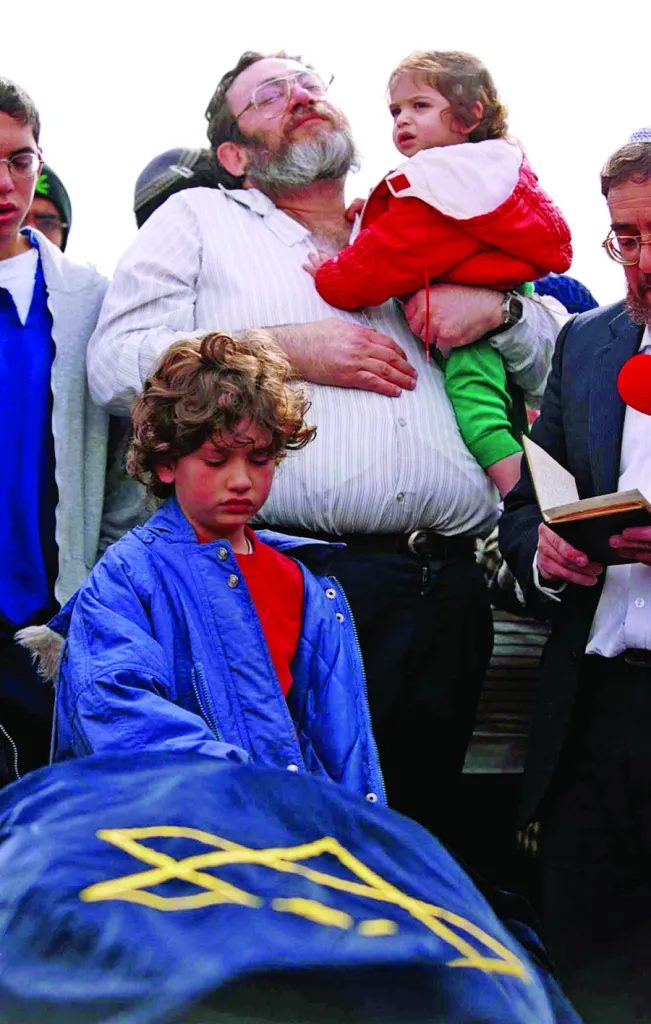
The war began on Oct. 7, 2023, when Hamas and other Iranian-backed proxies invaded Israel, perpetrating the largest slaughter of Jewish civilians since the Holocaust. More than 1,200 Israelis were murdered, often in their homes. Many were tortured and murdered in front of their loved ones, their deaths captured by gleeful terrorists who proudly filmed their atrocities. Some were burned alive. Others were raped in what is one of the largest examples of mass sexual violence in modern history.
Even now, two years later, the scope and scale of the depravity are hard to fathom. At the Nova Music Festival alone, nearly 400 people were murdered — the highest death toll of any concert-related tragedy ever. Documents taken from dead terrorists and from inside their lairs in Gaza revealed that they intentionally targeted community centers, day cares, and other places where civilians would be at their most vulnerable and helpless. This was their plan from the beginning.
Indeed, in October 2025, the New York Times published documents, including images of a six-page memo written by top Hamas commander Yahya Sinwar, showing that the carnage was part of the terrorist group’s strategy. It was no accident, nor was its savagery exaggerated. As part of its charter, Hamas calls for Israel’s destruction and the genocide of Jews. Oct. 7 proved, not for the first time, that Hamas means what it says.
Hamas also sought to weaponize Israel’s humanity and respect for human life, both by seizing hostages and by its well-honed tradition of using human shields. The terrorist group intentionally hid men, munitions, and command centers in densely populated civilian areas, including hospitals, schools, and United Nations facilities. It did so not only to slow or impede the inevitable Israeli response but also to murder its own people, thus creating a propaganda weapon.
The depravity of Oct. 7 is burned into the Israeli psyche. It has been made all the bitter by a profound sense of isolation and betrayal. From Western college campuses and city streets to the pages of the New York Times and the Washington Post, the Jewish state was depicted as having received its just deserts. Indeed, Israel was accused of “genocide” before it even responded militarily. As then-Washington Post columnist Karen Attiah reposted at the time: “What did y’all think decolonization meant? Vibes? Papers? Essays?” Their thinking? Israel, derided by the global Left as a “colonialist implant,” had it coming by dint of its very existence. Yet, a betrayal from such quarters, grotesque as it is, is hardly surprising.

More troubling has been the deterioration of support elsewhere. Pro-Israel sentiment in Europe has long been tepid at best. But as the scholar Walter Russell Mead documented in his excellent 2022 book, The Arc of a Covenant, the United States has a unique relationship with both the Jewish people and Zionism, the belief in Jewish self-determination. Indeed, more than any other Western country, the U.S. has been a refuge, intellectual and otherwise, for both. But this is changing.
A July 2025 Gallup poll, for example, found that only 46% of Americans sympathized with Israelis over Palestinians — the lowest level in a quarter-century of tracking. Further, only 32% of Americans approved of Israeli military actions in Gaza. This decline in support correlates with a growing chorus of efforts to delegitimize Israel and isolate it diplomatically. Being anti-Israel is now en vogue, the touchstone of everyone from low-IQ podcasters with large audiences to established members of the Senate and everyone in between. This is ominous. History is clear: The decision to single out Jews for opprobrium bodes poorly for the future well-being of Western civilization.
There are a number of explanations for the shift, which itself varies significantly by age, demographic, and political makeup. The bias of many news organizations certainly explains a lot. As organizations such as the Committee for Accuracy in Middle East Reporting and Analysis have documented, legacy media outlets often put anti-Israel narratives before facts, routinely treating claims by Hamas-linked entities as gospel. Other institutions have helped mainstream antisemitism and all of its derivatives. For example, irresponsible members of Congress, such as Reps. Rashida Tlaib (D-MI) and Ilhan Omar (D-MN), have regurgitated modern-day blood libels depicting Israel as uniquely evil and malevolent.
Israel alone is held to an impossibly high standard of self-defense. Adjusted for population, the Oct. 7 massacre was roughly the equivalent of more than 30,000 Americans murdered in one day — more than 10 times the number killed by al Qaeda on 9/11. No other nation would be expected to endure what Israel has suffered and not respond. No other country would be expected to allow such barbarians to sit comfortably on its borders.
But there’s another explanation, and it can be traced back to a single year and the slow, but steady, immolation of a cherished belief.
Many in the West, and not a few Israelis, believe that the Israeli-Palestinian conflict could be solved with a simple formula: in exchange for relinquishing land, the Jewish state would receive peace. Twenty-five years ago, that formula was put to its ultimate test — and it was found wanting. In fact, surrendering land only seemed to embolden Israel’s enemies, not placate them. It has taken Jerusalem a quarter of a century to fully imbibe this lesson, but many of its allies and critics still can’t bring themselves to acknowledge the truth. To understand why, one must go back to a more hopeful era.
The 1990s have been characterized as the “holiday from history.” The Cold War, the defining conflict of the post-World War II era, had ended — and in a far more peaceful fashion than many had predicted. The victor, the U.S., stood alone as the world’s sole, unchallenged superpower. The Soviet Union collapsed in 1991. Many of its former client states were either dissolving or looking to Washington for support.
As absurd as it now seems, there was even talk of a “peace dividend,” with Western lawmakers believing that savings from a diminished defense budget could be put to domestic uses. Equally absurd: It was thought that the Middle East, of all places, would be a good proving ground for peacemaking. Nor was this delusion limited to the U.S. Europeans and Israelis indulged, as well. In a 1993 book, Shimon Peres, the longtime Israeli politician and unfailing optimist, hailed what he called a “new Middle East,” one in which economic cooperation would upend centuries of internecine war and ethnic hatreds. It would be a reconstructed region that was “free of past conflicts” and finally ready to take its rightful place in the world. Things would be as they should have been, were it not for the decades of divisions prompted by the Cold War.
Some of the early returns seemed promising. In 1994, the Clinton administration managed to secure a peace treaty between Israel and Jordan, which the president hailed as turning a “no-man’s land” into “every man’s home.” President Bill Clinton said the agreement “reminds us that moderation and reason can and will prevail in the Middle East, that nations can put conflict behind them, that statesmen can lead people to peace.” And an even more promising white whale seemed to be within reach.
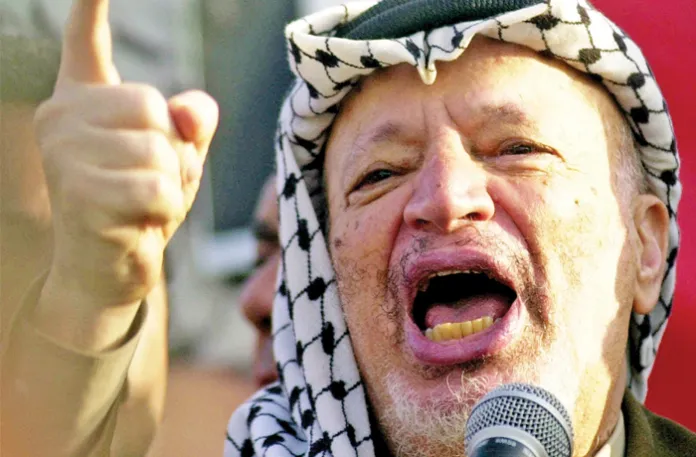
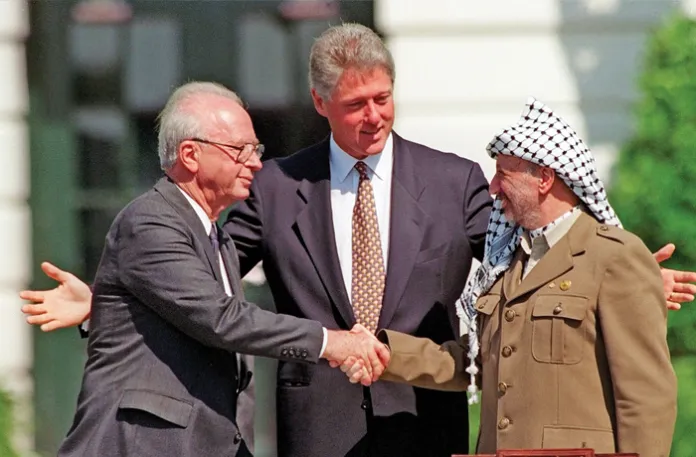
On Sept. 13, 1993, Clinton joined Israeli Prime Minister Yitzhak Rabin and Palestine Liberation Organization head Yasser Arafat for a signing ceremony on the White House lawn. Rabin, a veteran Israeli politician and famous general, was noticeably uncomfortable around Arafat, a longtime terrorist. In a preceding letter to Rabin and the Israeli government, Arafat pledged to renounce terrorism and to resolve outstanding issues in bilateral negotiations.
“The PLO considers that the signing of the Declaration of Principles constitutes a historic event, inaugurating a new epoch of peaceful coexistence, free from violence and all other acts which endanger peace and stability,” Arafat swore. “Accordingly, the PLO renounces the use of terrorism and other acts of violence and will assume responsibility over all PLO elements and personnel in order to assure their compliance, prevent violations and discipline violators.”
In exchange for these promises, the Israeli government recognized the PLO, until recently a designated terrorist group, to be “representative of the Palestinian people” and to “commence negotiations with the PLO within the Middle East peace process.” The PLO was allowed to return to Gaza and the West Bank from its exile in Tunisia. What became known as the Oslo process had commenced. It proved to be a lifeline for the Palestinian terrorist group and its leader.
The PLO, like most other major Palestinian terrorist groups at the time, had been dependent on Soviet largesse. And Arafat could no longer count on the Gulf Arab states. He had made the fateful decision of siding with Saddam Hussein when the Iraqi leader invaded Kuwait, his onetime patron. Arafat’s decision enraged the Kuwaitis, the Saudis, and virtually everyone else. The PLO chairman was down and out when the Oslo process revived his moribund fortunes.
But a leopard does not change its spots. Arafat had no intention of keeping his promises. Indeed, the very night of the signing ceremony, Arafat broadcast a speech in Arabic for his supporters, assuring them that they should understand the Oslo process in terms of the Palestinian National Council’s 1974 decision. This was a reference to the so-called “plan of phases,” in which the PLO would acquire whatever territory it could by negotiations, then use that land as a base for pursuing Israel’s annihilation. Arafat said all of the right things to the West and Israelis, but his real intentions, often uttered only in Arabic, were clear early on.
Indeed, in a May 10, 1994, speech in South Africa, and in another one on Aug. 21, 1995, at Al Azhar University in Cairo, Arafat compared his decision to participate in the Oslo process to deceptions that the Prophet Muhammad engaged in against rival tribes. Its purpose was for Arafat and the PLO to rebuild, consolidate, and then resume work toward Israel’s destruction. As he stated in 1996 remarks in Stockholm, “We plan to eliminate the State of Israel and establish a purely Palestinian state. We will make life unbearable for Jews by psychological warfare and population explosion. … We Palestinians will take over everything, including all of Jerusalem.”
The historian Efraim Karsh has noted that PLO official Faisal al Husseini even referred to the Oslo process as a Trojan horse “designed to promote the organization’s strategic goal: ‘Palestine from the [Jordan] river to the [Mediterranean] sea’—that is, a Palestine in place of the state of Israel.”
As Shoshana Bryen of the Jewish Policy Center observed, the PLO’s charter, which called for Israel’s destruction, was never amended, despite Arafat’s promises to do so. Indeed, upon his triumphant return to Gaza, Arafat literally smuggled prohibited terrorists with him, most notably Mamduh Nawfal, the mastermind of the 1974 Ma’alot attack, in which 27 Israeli schoolchildren were murdered.
Rabin was growing skeptical. By the time he was assassinated by an Israeli extremist in November 1995, the prime minister was pulling away from the Oslo process. In an Oct. 1, 2010 interview, his daughter Dalia said that “many people who were close to father told me that on the eve of the murder, he considered stopping the Oslo process because of the terror that was running rampant in the streets, and because he felt that Yasser Arafat was not delivering on his promises.” Shortly before he was assassinated, Rabin even told Moshe Ya’alon, a future defense minister, that, after the next election, “he was going to ‘set things straight’ with the Oslo process, because Arafat could no longer be trusted.” Indeed, as CAMERA has documented, terrorist attacks actually increased in the years after the Oslo process.
But many in the West, and not a few Israeli politicians, still had a vested interest in trying to make Arafat and the PLO something that they were not. Talks and even some agreements continued — but they did so in spite of constant delays and bad faith. By 2000, Clinton, at the end of his presidency, was desperate for a comprehensive agreement. Israel had withdrawn from Gaza and much of the West Bank, Judea and Samaria, allowing Arafat and the newly created Palestinian Authority the opportunity for limited self-rule. Arafat, at the nadir of his power less than a decade ago, now controlled the PA, the PLO, and the Fatah movement. Importantly, the PA was dependent on Western funds and training, including for the Palestinian National Security Forces that Arafat used to quash dissent.
During Israel’s elections, Clinton campaign advisers worked to oust Prime Minister Benjamin Netanyahu and his Likud party in favor of Labor, which they viewed as more amenable to the administration’s objectives, including a final status agreement with Palestinians, withdrawal from southern Lebanon, and an ever-elusive treaty with Syrian dictator Hafez Assad.
But talks with Assad went nowhere. Barak ordered a withdrawal from Lebanon, effectively ending Israel’s 18-year-long occupation of southern Lebanon. The withdrawal was completed in May 2000, six weeks ahead of schedule. The gambit failed. Iran’s foremost proxy, Hezbollah, filled the void, eliminating Israel’s allies in the south and further consolidating its grip on power. Israel had originally entered Lebanon in the early 1980s to take on the PLO, which fled to Tunisia. In the intervening years, Hezbollah’s power had only grown. Now the U.S.-designated terrorist group had the state to itself, and Israel’s intelligence assets and allies were in disarray. As importantly, Hezbollah claimed victory, presenting itself as having done what the PLO and others could not: vanquish the Israelis.
In July 2000, Clinton hosted Barak and Arafat for contentious talks at Camp David. Barak’s offer surprised even Clinton. Barak proposed to create something that had not ever existed: a Palestinian Arab state. More than 92% of the West Bank would be ceded, along with all of Gaza, and eastern Jerusalem, which would serve as its capital. Controversially, Barak even offered the Palestinians control over the Temple Mount, the most sacred ground in Judaism. However, Arafat wouldn’t budge. In 2001, in Tunisia, Clinton and his team encouraged Barak to make another offer for a Palestinian state. But this was refused by Arafat, who launched a terrorist war instead.
The so-called Second Intifada had begun. Fatah and its foremost rival for power, Hamas, and other Palestinian groups perpetrated a terrorist campaign that lasted nearly five years and murdered and maimed more than 1,000 Israelis. Peace had once seemed to be at hand. But now Israelis were murdered by suicide bombings, shootings, knife attacks, and car ramming, many while they were on buses or in cafes.
Documents seized during an August 2001 raid by Israel proved that Arafat and his minions were complicit in orchestrating the attacks. The evidence showed that Arafat had paid $20,000 to the al Aqsa Martyrs Brigade, a U.S.-designated terrorist organization. Arafat even personally signed checks for terrorists. Seized evidence also proved that the PA’s security services helped recruit, arm, and dispatch terrorists inside Israel.
In the span of a year, Israel ceded ground, literal and otherwise, to terrorists on several fronts. But instead of being satiated, they were emboldened. Israel’s opponents held firm to the idea that the “Zionist entity” was a temporary aberration, a “spider web” that could easily be swept away, as Hezbollah head Hassan Nasrallah was fond of saying. Islamists believe that any land once ruled by a Muslim power is forever theirs. Now they had proof that the Israelis weren’t in it for the long haul. Rather, they were weak and could be induced to retreat. It would take years for the Israelis and others to fully imbibe this — and only then at great cost.
Arafat’s terrorist war was self-defeating. By the time the PLO head died in 2004, the younger members of his Fatah movement were mostly in prison or dead. A colorless bureaucrat and terrorism financier, Mahmoud Abbas, took Arafat’s place. But Hamas, Fatah’s longtime rival, was now seen as the future of the Palestinian movement. In a final attempt at offering land for peace, Israel unilaterally withdrew from Gaza in 2005. Yet this only enabled Hamas to claim victory just as Hezbollah had done five years before. When elections were subsequently held, Hamas won, then ousted Fatah from Gaza in a brief and bloody war. Israel now had two Iranian-backed terrorist groups, Hezbollah and Hamas, to their north and south, respectively, along with a shaky and permanently politically weakened Abbas adjacent.
More wars would follow. In 2006, with Hezbollah. In 2008, 2012, 2014, and 2021, among others, with Hamas. In 2008, Israeli Prime Minister Ehud Olmert offered Abbas another opportunity for a Palestinian state, with more than 93% of the West Bank and a capital in eastern Jerusalem. Abbas, who pays tax-deductible salaries to terrorists, didn’t even make a counteroffer. Hezbollah, meanwhile, acquired more than 150,000 missiles, many of them precision-guided, making it the best-armed terrorist organization in the world.
For years, the West championed the idea that if Israel surrendered land, it would receive peace. This belief was held by American policymakers of both stripes and can even be found in think tank policy papers as far back as the mid-1970s. Nor was this purely an American conceit. The British held the same belief and had tried the same thing in the years before and immediately after World War II.
With the benefit of hindsight, 2000 can be seen as the year in which illusions were shattered and the modern Middle East was born. The course was set for a quarter-century of war. Popular opinion in Israel now shows a deep skepticism toward the formula of “land for peace.” Many in the West have yet to catch up, thinking that Israel just needs to surrender more. But Israel has reckoned with reality. Now it is everyone else’s turn.
Sean Durns (@SeanDurns) is a Washington-based foreign affairs analyst. His views are his own.