
EXCLUSIVE — The Trump administration will soon install 900 miles of buoy barrier at the United States-Mexico border, marking the first time the U.S. government has used a water-based defense system to stop illegal immigration, the Border Patrol’s national chief told the Washington Examiner.
Construction teams will start dropping the red-orange floating devices in the Rio Grande along Texas’ southern border in early 2026, Border Patrol Chief Mike Banks said.
“We’re going to start laying the first string of those buoys down in the Rio Grande Valley in the first part of 2026,” Banks said in a video interview on Dec. 19. “We’ve contracted over 500 miles of it. We’re looking at probably, ultimately, around 900 miles in the river in Texas.”
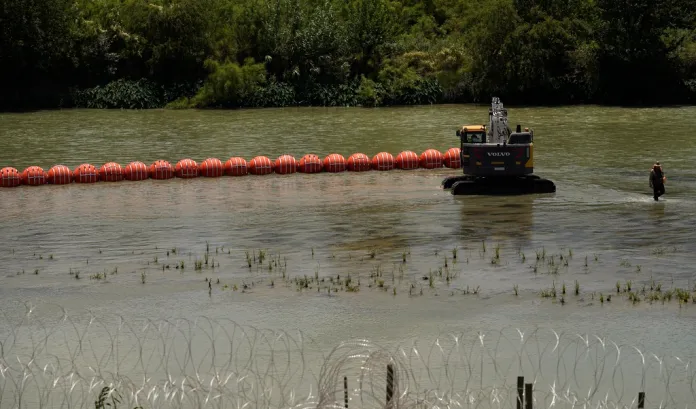
The only buoys used in border security in national history stretched roughly one mile in length and were installed by Texas during the Biden administration. This hefty addition will link up with Texas’s smaller project in Eagle Pass, and is expected to further reduce illegal border crossings, which are at 55-year lows.
The project was funded with money that Congress included in the One Big Beautiful Bill Act, which President Donald Trump signed into law in July.
The line of buoys is the latest flashy action that the Trump administration will take to carry out the president’s campaign promise of regaining control of the southern border following the Biden-era border crisis. The buoys are intended to prevent migrants in Mexico from wading across the river and entering the United States illegally.
Trump is “very aware” of the buoy project and has endorsed the plan, Banks said. He also said it is backed by Department of Homeland Security Secretary Kristi Noem.
“I have never seen this much support from a president and a secretary,” Banks said. “The support is even greater than it was in his first administration, as he’s continued to learn and grow in his understanding and knowledge on the border.”
The White House reiterated the president’s support for the Border Patrol.
”There’s no doubt that President Trump has expeditiously delivered on his promise to secure our border. While Biden let criminal illegals pour into our country and complained he couldn’t do anything to stop it, President Trump immediately proved him wrong, and the American people are safer for it,” White House spokeswoman Abigail Jackson wrote in an email Monday afternoon. “It’s amazing what happens when you have a President who believes in empowering Border Patrol to do their job.”
Where the buoys will float
The Texas-Mexico border is 1,250 miles long, comprising three-fifths of the entire southern border. The installation of the 900 miles of buoys will come in phases.
A 500-mile stretch of buoys that has already been contracted out will be laid from where the Rio Grande meets the Gulf of America near Brownsville, Texas, and stretch westward.
A second portion of 400 miles is still being finalized and will be installed on the south-central and southwestern sides of Texas.
The buoys will not be placed in areas that are too shallow to float; however, this could change in the coming months.
The Trump administration may greenlight additional buoys depending on the impact of Mexico’s recent decision to begin releasing water into the river at the western end of the river that had been withheld from Texas by the Mexican government, according to the chief.
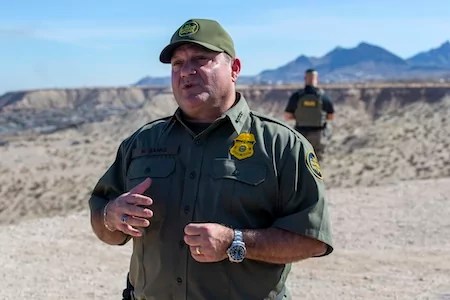
Banks plans to be present in Texas as the crew begins to install the buoys.
“It’s very important. It’s a huge milestone. And I think the, you know, talk about morale going up, Agents are really starting to see where all this planning has come to,” he said.
How buoys deter crossings
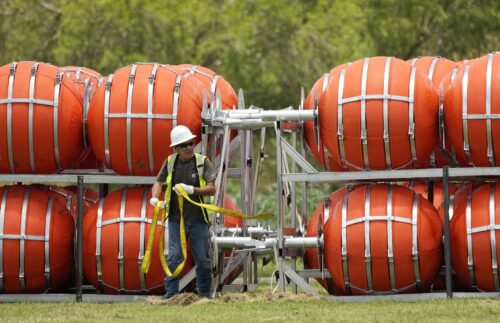
The forthcoming buoys are slightly smaller than the mile-long strand that Texas installed in 2023. The new ones will be up to six feet in diameter and cylinder-shaped, while the original buoys in Eagle Pass are round.
The buoys will be placed at the center of the river, right on the international boundary, unlike the physical border wall.
The buoys will also contain detection technology that will issue alerts for movement, effectively putting eyes in the water and allowing agents to patrol better.
The buoys serve as the initial barrier on the border line, while the existing physical steel wall on land will now serve as the second barrier.
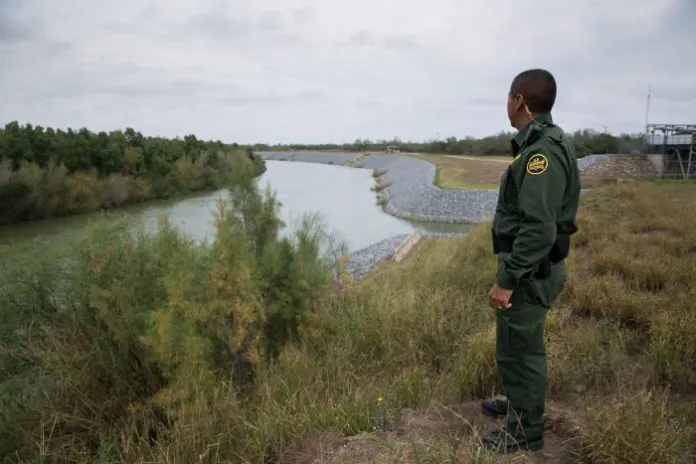
“The wall is several feet to as much as miles north of the border because of those floodplains along the river,” Banks said. “[The buoy barrier] allows us to put early detection and deterrence right down the center of the river on the actual international boundary line, and gives us that first point of detection of those trying to enter the country illegally.”
The buoys, in addition to the border wall, will give agents the chance to slow down anyone who can get over both. Several sections of the southern border feature a double wall in densely populated areas.
Selene Rodriguez, the campaign director for the Secure and Sovereign Texas campaign at the conservative Texas Public Policy Foundation think tank, said the buoys are a critical part of border security.
“A key component of border security is deterrence. Infrastructure that discourages people from attempting to illegally enter the United States is a positive investment, but it must be accompanied by intelligence, technology, and personnel,” Rodriguez wrote in a text message Monday.
How the buoys came to be
Border Patrol first began looking into a floating barrier during Trump’s first term in office. It was designed, tested, and evaluated. But former President Joe Biden, who stopped all border wall construction projects on his first day in office in 2021, opposed fencing off the border to would-be illegal immigrants.
“We had signed contracts. We were prepared to start deploying those buoys, and the Biden administration came in and said, ‘That’s infrastructure. We’re not going to do that,” Banks said.
The buoys are not a new concept to Banks. In January 2023, Gov. Greg Abbott (R-TX) tapped the recently retired federal agent to oversee the state’s border security operations as illegal border crossings surged during the Biden administration, and continued to spike through early 2024.
“When I left the Border Patrol and was appointed by Gov. Abbott to be the Texas border czar, we continued that project in Texas and started deploying those, and they did exactly what we thought they were going to do. They were a huge deterrent. They were almost impenetrable,” Banks said.
Although the Biden administration had killed the Border Patrol’s plans for a buoy rollout, Texas was willing to finance the project in a border town that was the epicenter of illegal crossings in 2023. The state laid a 1,000-foot string of buoys between Eagle Pass and the Mexican city of Piedras Negras, Coahuila.
Rep. Tony Gonzales (R-TX) represents more than 800 miles of the border, including Eagle Pass.
“Crossing the river is a deadly trek. Limited resources were diverted to dangerous rescue operations and, tragically, recovering bodies from the water,” Gonzales said in a statement. “Buoys are one more tool Border Patrol agents can use to deter illegal crossings, slow activity in the river, and prevent people from attempting to cross in the first place.”
However, the top Democrat on the House Homeland Security Committee said taxpayer money should have been appropriated elsewhere.
“Obviously, the money for this vanity project would be better spent reducing healthcare premiums for Americans,” said Rep. Bennie Thompson (D-MS) in a statement.
From a state asset to federal tool
Banks met with Trump in February 2024 when the presidential candidate visited Eagle Pass and spent time with Abbott’s team.
“[Trump] got to witness them firsthand,” Banks said. “He’s been impressed with them. I tell you, one of the things that I’m most impressed with about our president is that he understands that the United States Border Patrol knows how to secure this border, and he listens to us, and he supports us.”
Trump, impressed with Banks as the Texas border czar, moved Banks into his administration as the head of Border Patrol in January.
Texas still legally owns the buoys in Eagle Pass, but Border Patrol plans to seamlessly link the new buoy to the existing mile-long strand in Eagle Pass, as well as steel wall projects on land, including several that Texas competed for during the Biden administration.
The federal government will eventually purchase Texas’s portion.
A spokesman for Abbott told the Washington Examiner that the state has worked and will continue to work with the Trump White House on border security matters, such as this one.
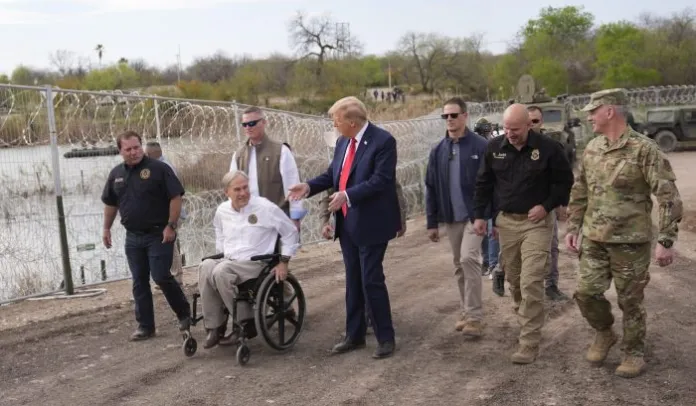
“Texas finally has a partner in the White House, and Governor Abbott continues to work closely with the Trump administration to uphold our nation’s immigration laws,” Abbott press secretary Andrew Mahaleris said in a statement. “The floating marine barriers deployed by Texas have been a resounding success, and Governor Abbott is proud to work with the Trump administration and Border Patrol to expand the program.”
Border security takes giant leap forward
Trump’s first year of his second term has primarily focused on planning and the early stages of construction, with implementation expected to occur in 2026.
“We’re a little ahead of schedule, which I like,” Banks said, adding that if “[Trump is] happy, I’m happy.”
To date, more than 20 miles of steel wall have been installed in the ground since January. The Border Patrol is averaging two miles of wall installed per week, as of mid-December, and intends to increase this to 10 miles per week, according to Banks.
Banks said the item at the top of agents’ wish lists is roads, due to the limited number of East-West roads along the border.
FAR FEWER FOREIGN APPLICANTS TO U.S. COLLEGES AMID TRUMP’S VISA CRACKDOWN
“All we need, and have proven time and time again to be effective where we have it, the most significant part, if you ask any Border Patrol agent, is being able to have that road that gives us that lateral access to rapidly deploy east and west along that border,” Banks said.
The forthcoming changes, Banks said, are already giving a boost to morale among Border Patrol’s nearly 20,000 personnel.