
Chase Strangio, the American Civil Liberties Union‘s go-to transgender lawyer for litigating its top LGBT cases before the Supreme Court, came out as binary-conforming after years of identifying as “nonbinary,” a term for someone who identifies as neither exclusively male nor female.
Strangio’s switch-up has raised eyebrows among opponents of gender ideology, especially as Strangio argues another ACLU case to force the federal government to recognize “nonbinary” status on identification documents.
As part of this apparent change, while speaking to the media, Strangio has also projected a new image as a peacemaker willing to reach across the political aisle. Strangio’s adversaries have said this willingness is newfound as well and indicative of the transgender lobby’s timely retreat in the wake of a crushing Supreme Court loss.
No longer ‘nonbinary’?
A biological woman who, until recently, went by both “he” and “they” pronouns, Strangio began telling the press in 2020 that while they identify as transgender and have since the mid-2000s, they do not see themselves solely as a man. At the time, Strangio said the sex binary “serves to oppress us.”
However, in a recent interview with the New York Times, Strangio noticeably embraced binary terminology.
When asked about the biological distinctions between the two sexes, Strangio said what determines “whether we are a boy or a girl” is one’s sense of self, as opposed to genitalia observed at birth.
“I would say that a man or a woman is someone who understands in their core that they are a man or a woman,” Strangio said in a Dec. 4 episode of the outlet’s podcast Interesting Times, fittingly titled, “The Shifting Politics of Transgender Rights.”
And on social media, Strangio now identifies as strictly male by listing only “he/him” pronouns. This is despite Instagram allowing users to mix and match their pronouns, such as pairing singular possessives with the gender-neutral “they/them.”
A softening tactic to ‘mollify’ the media
Some legal observers see Strangio’s sudden adherence to the sex binary, at least on the public front, as an attempt at damage control following a historic defeat at the highest court in the ACLU’s child gender-medicine case, United States v. Skrmetti, which dealt a devastating blow to the maximalist wing of the transgender movement.
Gender-critical attorney Glenna Goldis, a self-described “professor of Strangiology,” who has closely been documenting Strangio’s changing legal strategies, said Strangio seems to be reverting to a pre-Skrmetti playbook.
“The ACLU’s playbook from 2005 to 2024 was to make trans ideology sound scientific and compatible with the status quo,” Goldis told the Washington Examiner. “It did this by suggesting gender identity is based in biology, not challenging a binary view of sex, and exaggerating the role of medical doctors in transition[ing]. Its legal arguments were slick and simplistic.”
When the ACLU took on Orr v. Trump, its passport policy case, earlier this year, it departed from that playbook by suggesting that sex could mean different things in different contexts, Goldis said.
On behalf of the ACLU in Orr, Strangio is representing “nonbinary” clients who are suing the Trump administration, specifically the State Department, to be designated as such on government-issued travel documents, including U.S. passports, visas, and Global Entry cards.
Notably, the ACLU filed the lawsuit in February, months before the Skrmetti decision was handed down in June. Up until Orr, Goldis pointed out, the ACLU was strategically simplifying gender identity to male and female in court, intentionally making no mention of “nonbinary” status.
Goldis said Strangio’s “buttoned-up” interview with Ross Douthat suggests that the ACLU is withdrawing from the “spikier approach” it tried in Orr and returning to its old blueprint.
WHY THE TRANSGENDER MOVEMENT IS LOSING TRACTION, INSIDERS EXPLAIN
“I suspect this gambit is aimed at impressing the media,” Goldis said. “It looks like the Supreme Court is going to rule against the ACLU in every trans case that it sees, so to maintain its credibility, the ACLU must stay in the New York Times’s good graces.”
The outlet, in the immediate aftermath of Skrmetti, published a scathing piece analyzing what went wrong for the pro-transgender side. In it, the outlet’s political correspondent, Nicholas Confessore, found that the case was “built on flawed politics” and fueled by “theories of sex and gender that most voters didn’t grasp or support.”
That postmortem analysis, Goldis said, spurred the ACLU, and its de facto spokesperson Strangio, to take a more moderate tone on transgender matters.
Questionable talks of compromise during a vulnerable time for the ACLU
Strangio “appears to be in retreat mode,” agreed Kara Dansky, a former ACLU attorney and author of The TERF Report, a Substack newsletter dedicated to feminist content.
WHAT IS A TERF, AND WHY DOES IT MATTER IN TODAY’S POLITICAL CLIMATE?
Strangio also mentioned compromise and constructive discourse with the women’s rights resistance in the interview.
“I’m in favor of talking about compromise,” Strangio said when referring to barring biological boys from competing as girls in school sports, adding later on, “I’ve always been open to dialogue.”
“This is new, brand new,” Dansky said of Strangio’s peacenik persona. “Before that interview, Strangio had never indicated even the slightest interest in making peace.”
Dansky pointed to Strangio’s past derogatory remarks aimed at her. In 2019, Strangio accused Dansky, formerly senior counsel at the ACLU’s Center for Justice, of using her ACLU credentials to “legitimize her violent vision for trans death.”
“This is hardly suggestive of wanting to make peace,” Dansky, a lifelong Democrat who has never voted for President Donald Trump, told the Washington Examiner.
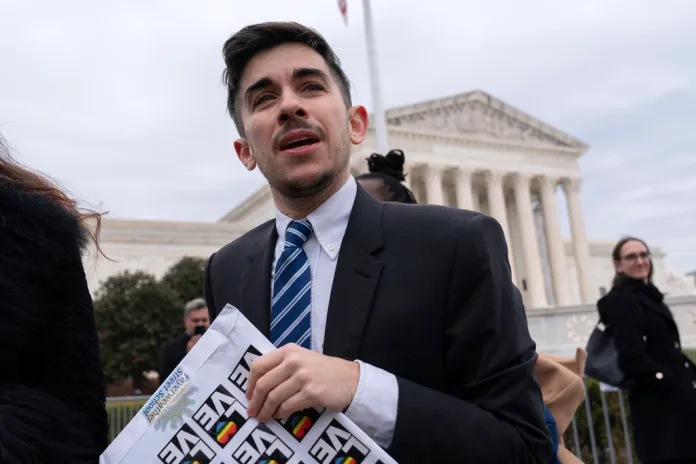
To Dansky, Strangio’s current position on single-sex sports is a total about-face, perhaps laying the groundwork for the ACLU’s two Supreme Court cases, Little v. Hecox and West Virginia v. B.P.J.
Strangio’s softening rhetoric about the goals of the transgender movement comes at a critical juncture for the ACLU, whose transgender sports cases, Hecox and B.P.J., are about to be heard back-to-back by the Supreme Court on Jan. 13.
Though nearly identical, Hecox was brought by an adult man on estrogen, targeting an Idaho law that mandates single-sex sports throughout the state, whereas B.P.J., which challenges a similar West Virginia statute, centers on a minor male whose puberty was medically suppressed. Ahead of oral arguments in January, the ACLU has moved, and subsequently failed, to withdraw its initial complaint in the Idaho case and asked the Supreme Court to dismiss the matter entirely.
ACLU ATTEMPTS TO YANK TRANSGENDER SPORTS CASE FROM SUPREME COURT DOCKET
As to why the ACLU considers Hecox moot, Dansky speculated that the ACLU knows it cannot convince a conservative-majority Supreme Court that fully formed adult male athletes should be considered women simply for declaring so or because they suppress their testosterone levels via cross-sex hormones. However, in B.P.J., the ACLU may be able to assert, with less pushback, that underdeveloped males can compete in female-only sports if they had their puberty blocked beforehand.
“That’s why it wants the Idaho case to go away, but is holding on to the West Virginia case,” Dansky explained.
Dansky said the ACLU must have thought it had a winning strategy because of Justice Neil Gorsuch’s 2020 opinion in Bostock v. Clayton County, which ruled that differential treatment based on someone’s “transgender status” is a form of sex discrimination in the workplace. Since then, the ACLU has prevailed in numerous court battles related to so-called transgender rights, often citing Bostock as case law, despite it only addressing workplace discrimination.
“I think that before the 2025 decision in Skrmetti, it counted on continuing its winning streak,” Dansky said. “And they were winning until they weren’t.”
Goldis noted that Orr is still snaking through the lower courts. The Trump administration will face long odds at the appellate level since it is in the pro-trans 1st Circuit, Goldis said, but it can be appealed to the Supreme Court, where the legal fight would fall under the media glare.
“How far will the ACLU go to keep their abandoned experiment off center-stage?” Goldis quipped.
It remains to be seen whether the ACLU will ultimately ditch its pending passport case as another lost cause. On Nov. 6, the Supreme Court sided with the Trump administration on a procedural dispute in Orr, allowing the U.S. government to issue passports containing biologically accurate sex markers as the appellate process plays out. It has not yet ruled on the underlying legal battle.
SUPREME COURT HANDS TRUMP A WIN ON PASSPORT BIOLOGICAL SEX RULE
Some onlookers surmise that the ACLU is aware that it pivoted too prematurely to championing nonbinary-ism, considered the next frontier of the war on sex for gender-expansionists.
“It’s beginning to dawn on them that they moved too quickly to persuade everyone on the face of the planet that sex isn’t real,” Dansky said, “or that if it is real, it’s less important than people’s made-up ‘gender identities.’”
On whether the tide is turning, Goldis thinks that the ACLU is merely trying to “mollify” the New York Times, which is read by a largely liberal audience, in light of Confessore’s criticisms.
“Strangio hasn’t made any meaningful concessions to her opponents,” Goldis said. “The only substantive point she pretends to have shifted on is protecting girls’ sports.”
In the post-Skrmetti appearance on Douthat’s podcast, Strangio said, “I do accept that sex-separated sports is an important part of preserving women’s opportunity in sports right now.”
“First, what is a woman?” Goldis countered. “Second, she says ‘right now.’”
“Third,” she continued, “even if Strangio is ceding that some sex separation in sports is OK, that’s an empty concession because it’s going to happen no matter what the ACLU does. President Trump is on the warpath against schools that make girls compete against boys, and the Supreme Court will back him up. The idea of mixed-sex school athletics only got as far as it did because President Biden refused to enforce Title IX appropriately.”
CLEARING UP THE CONFUSION SOWN BY BIDEN’S REWRITE OF TITLE IX
Goldis suspects that Strangio is only calling for compromise as a tactic to make the opposition seem unreasonable.
For instance, in the interview with Douthat, Strangio described feeling “very hesitant” to call things transphobic “without having an opportunity to try to have conversations,” insisting, “I want to understand where people’s anxieties are. I want to find places where we might agree.”
In contrast, Dansky said Strangio is simultaneously positioning the transgender side as sensible.
“People who champion ‘trans’ know they’re starting to lose both in actual court and in the court of public opinion,” Dansky said. “So they have to revert to ‘reasonableness.’ That means acknowledging that women have a right to female-only sports, while maintaining that men and boys who have had their puberty blocked have a right to be in them.”
Strangio unmasked
In the same vein, Strangio is pretending to be binary, Goldis said.
Strangio has a reputation for adapting a public image to whatever the moment demands, even if it is not exactly aligned with a nonbinary worldview, critics say.
Goldis noted that when Strangio argued before the Supreme Court, marking the first time an openly transgender-identifying person presented arguments in front of the high court, Strangio went by “Mr. Strangio,” a gendered title, instead of the nonbinary honorific “Mx,” an ambiguous form of address often used by nonbinary people, with the “X” symbolizing a wildcard character.
SUPREME COURT USES PREFERRED HONORIFIC FOR FIRST-EVER TRANSGENDER LAWYER IN ARGUMENTS
However, Strangio has discussed wanting to abolish the sex binary altogether. In fact, it’s a long-held objective. Strangio’s admitted agenda, the end goal of all this litigation, is to “destabilize” the biological categories of sex through lawfare.
“When I litigate these cases…my hope is that we can sort of destabilize the assumptions about our bodies and, in turn, the spaces that are supposed to be responsive to them,” Strangio told the University of Minnesota’s Transgender Oral History Project.
In that 2020 interview, Strangio acknowledged the goal of overhauling how civil rights law sees sex.
“And I think we are starting to see some of that, where we’re starting to see courts say things like, ‘this notion of biological sex is arbitrary, that you can’t divide people neatly into categories, you can’t shunt people off into separate spaces just because they don’t fit into categories,’” Strangio said. “And so hopefully there’ll be a way to start to really think about, ‘Well, how, is there a way the law can be used to start to destabilize the categories themselves?’”
Strangio has maintained this anti-binary mindset in public until quite recently. In April, Strangio told Cultured magazine, “What I tell myself every day is that the confusing, unsettling nature of transness for other people is the thing that will spark the revolution we need. It’s the uncertainty, the inbetweenness, the traversing of binaries that we offer that’s gonna destabilize the whole thing.”
During the discussion with the University of Minnesota, Strangio indicated that when picking plaintiffs for transgender cases, the ACLU tends to stick to binary conformists, or people who simply want to be treated as the opposite sex, rather than outright dismantle the sex categories.
Strangio’s radical aspirations of breaking the sex binary, even if shared by ACLU colleagues, are not as palatable to the transgender movement’s more moderate allies, who can wrap their minds around men wanting to become women, and vice versa, but may stop short of accepting that someone identifies as something other than entirely male or female.
Expressing discontent, Strangio criticized this strategy of working within a binary framework.
“We can convince ourselves that, ‘Oh, once we get into those [sex-segregated] spaces, we start to break them down.’ But that’s also what we said about marriage. ‘Oh, let queers in, and we’ll blow it up from the inside,’ That did not happen,” Strangio said.
Strangio believes that marriage is fundamentally a “violent institution.” When the Senate moved toward passing the Respect for Marriage Act, a 2022 marriage equality bill, Strangio took to Instagram to say, “I feel an inexplicable amount of rage witnessing the Senate likely overcome the filibuster to vote to codify marriage rights for same-sex couples.”

“A significant part of my career has (begrudgingly) been devoted to marriage-related litigation,” Strangio lamented. “I find it disappointing how much time and resource went into fighting for inclusion in the deeply flawed and fundamentally violent institution of civil marriage.”
Similarly, in a 2021 “manifesto” on gender, Strangio said the binary categories of sex are “colonial and supremacist” in nature.
Strangio’s disregard for the sex class harkens back to a declaration that Strangio made in a 2019 interview with NBC’s Chris Hayes: “I am a civil rights and constitutional lawyer, who fundamentally doesn’t believe in the Constitution and the legal system.”
Critics have noted that despite such radical rhetoric, Strangio has ascended to a top position at a storied institution.
“It’s interesting to note that the ACLU didn’t rein Strangio in for many years, even when she was dumping on gay marriage and the Constitution,” commented Goldis. “Instead, it promoted her. Anthony Romero [head of the ACLU] must have thought her provocative behavior benefited the ACLU.”
Still, in the University of Minnesota interview, Strangio acknowledged that the ACLU’s legal warfare is successfully obfuscating what it means to be a woman, away from its biological definition.
LAWFARE TARGETING TRUMP’S GENDER ORDER THREATENS PROTECTED STATUS FOR WOMEN
“Even though the binary is existing in the work that we’re doing, and we’re talking about, ‘Oh, trans women are women,’ and thereby reifying the category of woman,” Strangio remarked, “we’re also sort of destabilizing it at the same time by saying, ‘Well, what do we mean, when, and why?’”
The Washington Examiner contacted Strangio for comment.