
President Donald Trump‘s administration has been marked by a renewed relationship with key Silicon Valley players this time around.
Elon Musk was a skeptic of Trump during his first White House term. But in 2024, with Trump seeking a comeback after losing in 2020, Musk spent considerable time, effort, and money campaigning for the former president. This year, with Trump back in office, Musk helped kick-start the Department of Government Efficiency‘s efforts to reduce government expenditures significantly.
There remain plenty of less gung-ho examples of the new special relationship between Silicon Valley and the White House. These are tech business folks who were generally hostile to Trump leading up to and during his first term, but have had second thoughts and now support at least some aspects of the White House’s agenda.
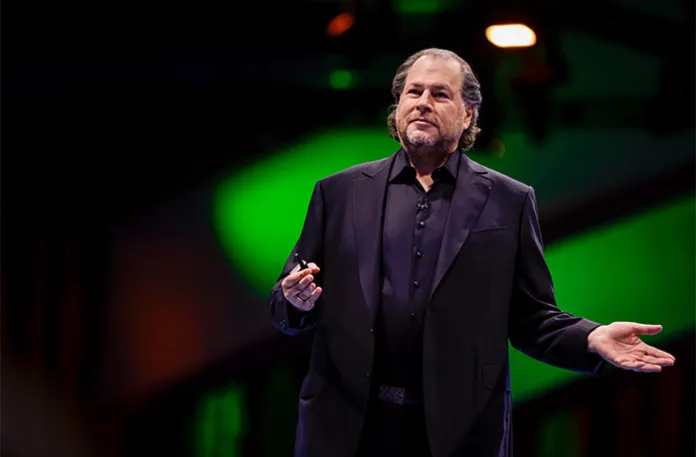
Exhibit A of this phenomenon could be Marc Benioff, founder and CEO of Salesforce and current owner of Time magazine. He was once credited with starting a “new era of corporate social activism” and is almost a textbook example of a California tech entrepreneur who struck Silicon gold. He has not only succeeded but also written several books on his success.
Benioff recently posted pictures of himself on his X account at a Trump White House dinner. One picture showed him smiling broadly with Attorney General Pam Bondi. He captioned it: “White House Dinner Update: Benioff and Bondi Declared ‘Most Likely to Start a Party.’”
Benioff has also responded well to some Trump initiatives. Commenting on the temporary federal takeover of Washington, D.C., law enforcement in August, he suggested the administration also send National Guard troops to the crime-ridden streets of San Francisco, his hometown, where most Salesforce employees are located. (Benioff later apologized for the suggestion after protests.)
There is a debate in business circles over how best to deal with the Trump-controlled executive branch, which boils down to ostracism versus engagement. Former Trump opponent Hillary Clinton gave force to the first one by calling Trump supporters a “basket of deplorables.” Comedian and commentator Bill Maher has championed engagement, earning attaboys from Benioff.
“Talking with people we disagree with isn’t endorsement — it’s courage,” Benioff wrote on X in late November. “Shutting down dialogue doesn’t protect ideas; it suffocates them. Innovation, understanding, and healing always begin at the same table, especially when it feels uncomfortable. Let’s choose conversation over cancellation. That’s the America I believe in.”
From Clinton to Trump Time
Such statements mark a difference, in emphasis at the very least, from many of Benioff’s past engagements with politics. Mike Pence was Trump’s vice president for his first term. Immediately before that, Pence was governor of Indiana, where the Republican state chief executive came to political blows with Benioff.
In 2015, Pence signed a bill that sought to restore some religious freedoms at the state level. “On its face, the bill would enable people of faith to resist unwelcome governmental infringement on their principles,” Benioff wrote in his 2019 memoir Trailblazer, but he was not buying it.
“In practice, however, we knew it was designed to give the state’s business owners legal cover to discriminate against LGBTQ customers if their religious views compelled them to do so,” he added.
Benioff’s company played hardball, threatening to close up shop there and pull thousands of good-paying jobs out of the Midwestern state. Other big businesses followed suit. Pence folded quickly and signed clarifying legislation that watered down the legal force of the original law.
Benioff opposed the Trump-Pence ticket by endorsing their opponents.
“If you want to defeat Donald Trump, and you’re that upset about him, then you should support Hillary Clinton, which is what I’m doing,” he told the HuffPost in June 2016. He praised the Democratic presidential nominee-in-waiting’s stance on her “LGBT equality,” “economic policies,” and “experience.”
Still, his candidate lost, and Benioff has tried to make the best of it.
“I personally held a fundraiser for Hillary Clinton during the 2016 campaign, but I had no problem coming to the Trump White House in my capacity as a business leader to talk about workforce development and technology training programs,” he wrote. “Salesforce is not a political organization, and our values don’t come with party affiliations.”
Benioff acquired Time in 2018 for $190 million. Time awarded Trump its Person of the Year laurel because of his comeback reelection in 2024, and Benioff had only congratulatory things to say.
“This marks a time of great promise for our nation,” he wrote on X. “We look forward to working together to advance American success and prosperity for everyone. May G-d bless the United States of America.”
All-in on AI
Salesforce has taken up the bulk of Benioff’s professional life. The CEO founded the company and has made a great deal of money from it, in addition to returns on other investments. The Bloomberg Billionaires Index estimated his net worth at $10.8 billion.
Salesforce began offering customer relationship management services to other firms in 1999 and has expanded into more areas. For instance, it bought the popular business chat platform Slack in 2021 for $27.7 billion. The company’s revenues have increased steadily over the past decade, from $5.3 billion in fiscal 2015 to $37.8 billion in fiscal 2025. It had a market cap of over $247 billion at press time.
Benioff’s company is all-in on artificial intelligence.
“Salesforce is the world’s #1 AI CRM, and helps businesses use their customer data and AI to work smarter, be more responsive, and build better relationships with their customers,” Salesforce explains on its website.
One branch of the company, Salesforce Ventures, is investing $1 billion in AI-focused companies.
“To date, the fund has invested in 35 AI-first companies whose combined valuations have soared to over $270 billion,” Salesforce announced in mid-October. Moreover, the company also announced plans to invest $15 billion in San Francisco over five years on different initiatives aimed at “reinforcing the city’s status as the world’s AI capital.”
This commitment may provide some insight into Silicon Valley’s and Benioff’s closer relationship with Trump this term. Former President Joe Biden’s team was skeptical of advances in AI and sought to slow it down with investigations and regulations. This prompted many tech entrepreneurs to seek practical political alternatives.
JOHNSON GIVES 10 OPTIONS TO ADDRESS HEALTHCARE COSTS, NONE OF WHICH INVOLVE OBAMACARE SUBSIDIES
Trump, whose approach to business and politics is famously transactional, saw an opportunity and took a different approach. Since returning to the White House, the Trump administration has embraced AI with gusto. This has driven so much investment into that space that analysts are currently worrying about an AI bubble and what that could mean for the wider economy if it bursts.
Jeremy Lott is the author of several books, most recently, The Three Feral Pigs and the Vegan Wolf.