
EXCLUSIVE — Employees across the Department of Commerce and its major bureaus, including the U.S. Patent and Trademark Office, National Oceanic and Atmospheric Administration, and Census Bureau, are still required to submit monthly “five things” accomplishment emails, even though the rest of the federal workforce no longer has to.
According to a copy of an internal message obtained by the Washington Examiner, the Patent and Trademark Office reminded employees this week that their “Five Things” for November were due on Dec. 1. “Please reflect on your accomplishments for November and submit your five items,” Anne Mendez, acting chief administrative officer, wrote, directing staff to send the list up the chain of command. Employees said similar reminders have circulated across the Commerce Department and its bureaus.
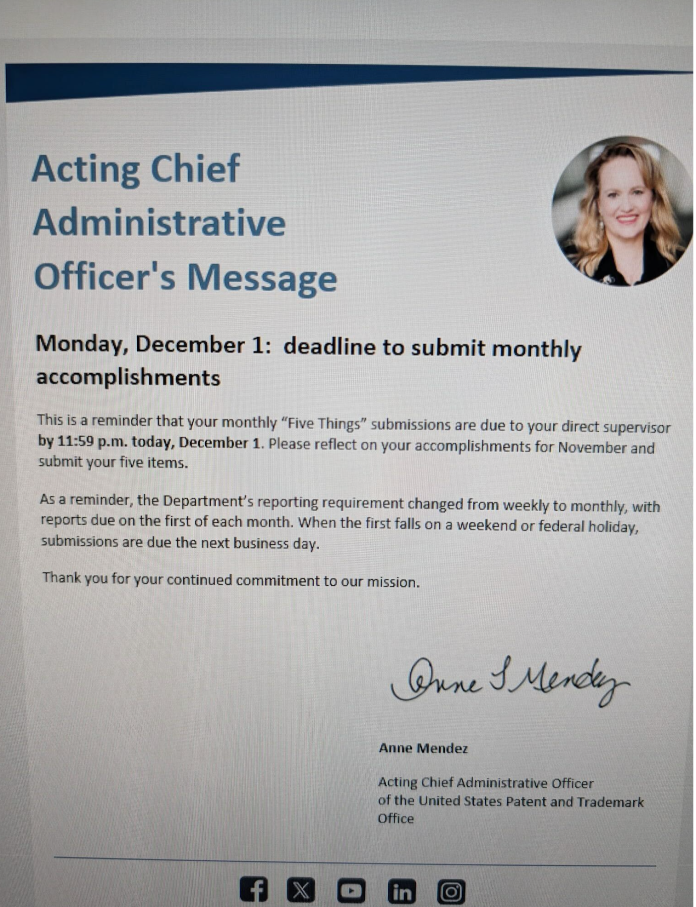
Employees said the message reflects a broader pattern within the Commerce Department, in which the reporting requirement has persisted even as the rest of the federal government has moved on. The Washington Examiner spoke with a handful of employees working at the Commerce Department and the agencies under its umbrella, all of whom requested anonymity because they were not authorized to speak to the press. Workers described the monthly reports as unnecessary, outdated, and a holdover from an initiative most agencies abandoned months ago.
“Yes, we are still doing the monthly five bullets, very unnecessary,” one Patent Office employee said, adding that some offices “bend backward” to keep the practice alive to show compliance. That employee also said the bureau has tightened performance plans this year, made “fully successful” the new standard, restructured bonuses, and increased the workload required to meet expectations.
Other Commerce Department employees shared similar experiences, noting that the requirement quietly shifted from weekly to monthly reporting in August. One described the monthly reports as “an absolute waste of time and energy.” Another said “all of Commerce” moved to five-bullet reflections each month. A third recalled that one of the first reminders delivered during a post-shutdown all-hands meeting was to complete the monthly “five things” and called the directive “insane.” A former Census Bureau employee said leaving the agency in October meant finally escaping the “BS bullets.”
The persistence of the reporting requirement at the Commerce Department comes months after the Office of Personnel Management withdrew from the process. In August, OPM Director Scott Kupor told agencies that “OPM was no longer going to manage the five things process nor utilize it internally,” and emphasized that managers already had “many other existing tools” to stay informed about employee performance. Most federal departments stopped collecting the bullet-point reports shortly after.
The “five things” directive began in late February as a hallmark of the White House’s Department of Government Efficiency and mirrored a familiar Elon Musk management tactic. Musk, then affiliated with DOGE, announced the requirement on his social media platform X and warned that failure to respond would be treated as a resignation.
According to the White House, more than a million federal employees complied during the first week, a figure White House press secretary Karoline Leavitt highlighted at a press briefing when announcing that workers submitted their bullet points to supervisors and copied OPM.
The rollout immediately met resistance across some agencies. Some warned employees to answer cautiously, while others instructed them not to respond at all. The directive revived long-standing concerns about data security, following the OPM’s 2015 cyber breach, which exposed personal information for roughly 22 million people.
Meanwhile, DOGE remains the subject of political scrutiny. Reports last month suggesting the temporary agency was shut down prematurely drew attention across Washington, though the administration denied the claims. DOGE’s reduced visibility after Musk left in May prompted conservatives to revisit what they view as the office’s shortcomings and to argue that Republicans could have done more to shrink the federal workforce.
This month, DOGE claimed more than $215 billion in savings from contract cancellations, workforce reductions, and asset sales. However, critics say the figure is substantially inflated and still far from Musk’s $2 trillion target. The estimate also excludes the costs of litigation, rehiring, retraining, and reduced IRS revenue. DOGE also reported eliminating about 300,000 federal jobs, but the Partnership for Public Service estimated the actual number to be closer to 199,000, including roughly 135,000 departures through the deferred-resignation program.
WHITE HOUSE IMPLORED TO INSTITUTIONALIZE DOGE AFTER REPORTS OF PREMATURE DEMISE
Inside the Commerce Department, employees said the reporting requirement and the culture behind it never really went away. Several told the Washington Examiner that the department’s insistence on continuing the monthly “five things” practice reflects the lingering reach of DOGE long after most agencies stopped participating. One worker said the idea that DOGE is gone is “absolutely false,” adding, “DOGE has metastasized into every agency.” Another said inside the Commerce Department, “DOGE is very much alive and well. They’ve just buried themselves into different agencies.”
The Washington Examiner reached out to the Commerce Department for comment.