
U.S. special envoy to the Middle East Steve Witkoff has an appointment at the Kremlin, but his peace proposals seem like they will be dead on arrival.
Witkoff will fly to Moscow on Tuesday with a new plan for peace hashed out among himself, Secretary of State Marco Rubio, Jared Kushner, and a Ukrainian delegation that met them in Miami on Sunday. The “updated and refined peace framework” replaces the initial 28-point plan floated last month, which outraged Ukrainian supporters due to its heavy-handed concessions to the Kremlin.
Kremlin spokesman Dmitry Peskov confirmed Monday that the “meeting with Witkoff is planned for tomorrow” during the “second half of the day” — but just last week, Putin declared at a security summit in Kyrgyzstan that striking any deal with Ukraine is “impossible legally” at the present moment.
“Broadly speaking, of course, we ultimately want to reach an agreement with Ukraine. But right now, this is practically impossible,” the Russian leader said, reemphasizing his belief that the Ukrainian government is illegitimate and therefore unable to make deals with Moscow.
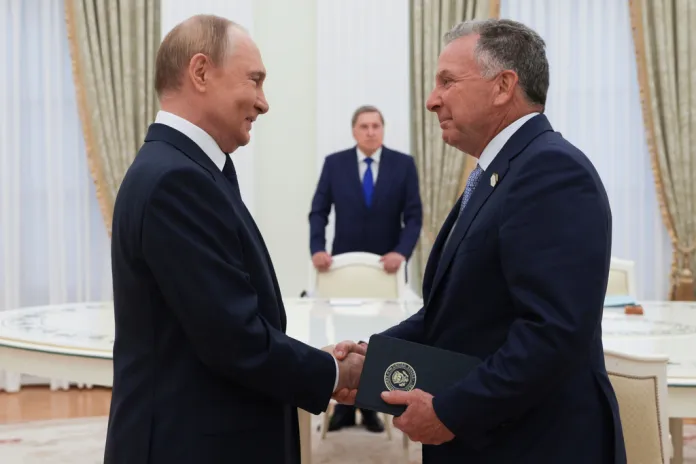
“In general, we agree that this could form the basis for future agreements, but it would be rude of me to talk about any final versions now, since there are none,” Putin said, paying light lip service to the U.S.-led efforts for peace. “Some things are fundamental in nature, and in general, we see that the American side is taking into account our position, which was discussed before Anchorage and after Alaska.”
The Russian president’s comments do not bode well for the U.S.-led proposal, the updated tenets of which have not been made public.
Douglas Klain, deputy director for policy and strategy at advocacy group Razom for Ukraine, told the Washington Examiner that negotiations have entered a “confusing and much more opaque situation” than when the 28-point plan was first revealed.
The leaked document, made public last month, included a cutoff of American intelligence sharing and an end to European-financed weapons packages — as well as significant territorial concessions and a limit on Ukraine’s military capacity.
Klain told the Washington Examiner that Ukraine’s strategy in negotiations is to always sit down at the table and participate, allowing Russia to frustrate the United States with its perpetual reneging.
“Ukraine has to present itself as the party that is always ready to say yes to [President] Donald Trump here,” Klain said. Trump has “been clear that he does see Zelensky as the obstacle to peace at times and is obviously much more willing to exert pressure on Ukraine than Russia.”
“And so Ukraine just does not want to give any excuse for the White House to turn its sites back on Kyiv rather than Moscow,” he added.
Trump’s fickle attitude toward Ukraine was highlighted during a Monday press conference, in which White House press secretary Karoline Leavitt was asked about the recent corruption scandal that threatened to undermine Ukrainian President Volodymyr Zelensky’s political strength domestically and abroad.
The president “does not want to see American tax dollars taken advantage of, which is why he has stopped the endless checks that were being written by the previous administration to fund this war,” Leavitt said.
She called the current arrangement of U.S. weapons being sold to NATO for use in Ukraine a “very different thing than the American people writing blank checks to a war effort very far away.
“It does not degrade the administration’s determination to see this war comes to an end, but I think it exemplifies the president’s desire to always put the American people and the American taxpayer first,” she added.
Meanwhile, Zelensky met with French President Emmanuel Macron at the Élysée Palace on Monday, speaking extensively about hypothetical “security guarantees” if the U.S.-led peace plan is finalized.

In a post-meeting press conference, Zelensky told the press that “three main components” remain problematic in ensuring Ukrainian sovereignty following a deal and that officials “need to be very cautious.”
He called the “territorial issue” the “most difficult” point — referencing proposed swaps of land and concessions of Ukrainian territory in exchange for peace. He also touched on the necessity of financial support and security guarantees from Europe and the U.S.
Rubio called the negotiation process “delicate” and “complicated” while speaking to the press on Sunday.
TRUMP SAYS ZELENSKY CORRUPTION SCANDAL ‘NOT HELPFUL’ FOR PEACE EFFORTS
“We continue to be realistic about how difficult this is, but optimistic, particularly given the fact that as we’ve made progress, I think there is a shared vision here that this is not just about ending the war,” the secretary of state said.
Trump has accused Russia multiple times of “tapping along” U.S. negotiators, complaining in July that the White House gets “a lot of bulls*** thrown at us by Putin.”